Cyber Security
10 Best AI Cybersecurity Tools in 2026
Pawan PanwarMay 3, 2026
Preparing your workspace...
Loading latest data
Loading article...
Preparing blog content
Do you know what an AI Cybersecurity Tool is and how it improves cybersecurity measures? If not, then you are at the right place. Here, we will talk about The 10 Best AI Cybersecurity Tools in 2026 and explore what they offer.
Moreover, we will introduce you to a reliable cybersecurity tool offered by a reputable VAPT service provider. What are we waiting for? Let’s get straight to the topic!
AI-powered cybersecurity technologies can detect, anticipate, and eliminate sophisticated cyberthreats more quickly than human teams by using machine learning and sophisticated algorithms to independently evaluate large datasets.
These systems identify small irregularities that indicate possible breaches or insider threats in real time by setting dynamic baselines for network behavior. By automating incident response and lessening the strain of manual monitoring in an increasingly complex threat landscape, they ultimately act as a force multiplier for security operations.
Let’s take a look at The 10 Best AI Cybersecurity Tools in 2026, find out what is best for you, and why you should use them!
|
S.No. |
Benefits |
How? |
|
1. |
Enhanced Threat Detection |
It uses pattern recognition to find attack signatures and complex, covert malware that conventional, rule-based security solutions frequently miss. |
|
2. |
Real-Time Anomaly Identification |
It creates dynamic network baselines to quickly identify anomalous activity or illegal access, allowing for quicker action in the event of a possible breach. |
|
3. |
Automated Incident Response |
Without requiring human participation, it isolates compromised systems and eliminates threats by executing pre-established security measures. |
|
4. |
Predictive Threat Intelligence |
It forecasts new attack vectors by analyzing global data trends, enabling enterprises to strengthen defenses before a vulnerability is actively exploited. |
|
5. |
Operational Efficiency |
It greatly lessens the cognitive load on analysts and speeds up incident response times by automating repetitive security duties and procedures. |
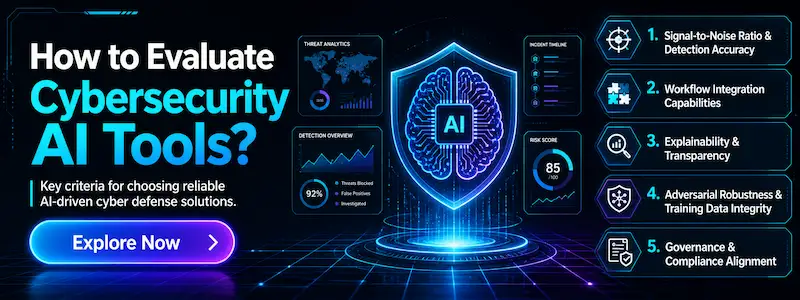
In the following ways, you can evaluate cybersecurity AI Tools:
● Signal-to-Noise Ratio & Detection Accuracy: Make sure security teams stay focused on real threats by giving priority to tools with low false-positive rates.
● Workflow Integration Capabilities: To ensure uniform visibility and response time, make sure the API is seamlessly compatible with the current security stacks.
● Explainability & Transparency: Give preference to "white-box" models that offer a transparent explanation for alarms, allowing for quicker examination and more confidence in automated judgments.
● Adversarial Robustness & Training Data Integrity: Check the model's resistance to both complex AI-generated evasion tactics and data poisoning.
● Governance & Compliance Alignment: Verify that the solution supports strong auditability while adhering to regulatory frameworks and data protection standards.
The following are some of the Top 10 AI Cybersecurity Solutions for 2026:
1. ThreatFusionAI: Craw Security created ThreatFusionAI, a unique threat intelligence database that uses artificial intelligence to detect, track, and eliminate new cyberthreats.
a) Pros:
● AI-Driven Intelligence,
● Proactive Defense,
● Customized for Defense,
● Infrastructure Synergy, and
● Actionable Insights.
b) Cons:
● Proprietary Nature,
● Implementation Dependency,
● Specialized Focus,
● High Barrier to Entry, and
● Resource Requirements.
2. Snyk: Snyk is a developer-focused, AI-native security platform that finds, ranks, and automatically fixes vulnerabilities in custom code, open-source dependencies, containers, and infrastructure-as-code by integrating directly into the software development process.
a) Pros:
● Developer-Centric Workflow,
● Automated Remediation,
● Proprietary Intelligence,
● Contextual Prioritization, and
● Full-Stack Security.
b) Cons:
● False Positive Rates,
● Pricing Scaling,
● Learning Curve,
● Tooling Fatigue, and
● Dependency on CI/ CD.
3. Checkmarx One: To provide correlated risk insights and automated remediation from code to cloud, Checkmarx One is a unified, cloud-native application security platform that integrates testing such as SAST, SCA, DAST, and API security into a single console.
a) Pros:
● Unified Security Ecosystem,
● Developer-First Integration,
● Advanced AI Remediation,
● Correlated Risk Insights, and
● Scalable Infrastructure.
b) Cons:
● Complexity for Beginners,
● Potential for False Positives,
● Premium Pricing,
● Interface Feedback, and
● Set up Dependency.
4. Semgrep: Semgrep is a lightweight, open-source static application security testing (SAST) tool that uses semantic pattern matching to discover faults that appear and feel like standard code in order to scan code for security flaws, secrets, and dependency problems.
a) Pros:
● Fast & Lightweight,
● Customizable Rule Engine,
● Developer-Friendly,
● AI-Assisted Remediation, and
● Large Community Support.
b) Cons:
● Tuning Requirements,
● Steep Learning Curve,
● Narrower Out-of-the-Box Scope,
● Governance Complexity, and
● Resource Scaling.
5. Veracode: Veracode is an all-inclusive, cloud-native application security (AppSec) platform created for businesses. It offers a unified set of testing techniques, such as software composition analysis (SCA), dynamic analysis (DAST), static analysis (SAST), and manual penetration testing, to find and fix vulnerabilities at every stage of the software development lifecycle.
a) Pros:
● Holistic Security Suite,
● Enterprise Governance & Compliance,
● High-Assurance Accuracy,
● Actionable Remediation, and
● Scalable SaaS Architecture.
b) Cons:
● Slower Feedback Loops,
● Steeper Learning Curve,
● Pricing Complexity,
● Integration Friction, and
● Deployment Constraints.
6. GitHub Advanced Security (GHAS): Designed to automate vulnerability detection, manage secret exposures, and secure the software supply chain directly within the developer workflow, GitHub Advanced Security (GHAS) is an enterprise-grade suite of security tools built into the GitHub ecosystem.
a) Pros:
● Native Ecosystem Integration,
● Proactive "Push Protection",
● Advanced Static Analysis (CodeQL),
● Automated Remediation (Copilot Autofix), and
● Unified Visibility.
b) Cons:
● GitHub Dependency,
● License Requirements,
● Limited CI/CD Scope,
● Customization Constraints, and
● Tooling Silos.
7. Black Duck: Black Duck is a complete application security platform that offers deep visibility into open-source components, license compliance, and security flaws throughout the whole software supply chain, from source code to binaries and containers. It is widely regarded as the industry standard for Software Composition Analysis (SCA).
a) Pros:
● Unmatched SCA Precision,
● Robust Compliance Management,
● Unified Security Suite,
● Flexible Deployment, and
● Comprehensive SBOM Generation.
b) Cons:
● Resource Intensive,
● High Learning Curve,
● Enterprise-Grade Pricing,
● Triage Overhead, and
● Less Developer-Centric.
8. GitGuardian: In order to prevent unintentional data leaks and unauthorized access, GitGuardian is a top code security platform that specializes in the automated detection and remediation of "secrets" like API keys, database credentials, and certificates within source code, developer tools, and throughout the software development lifecycle (SDLC).
a) Pros:
● Specialized Secret Detection,
● Developer-Friendly Integration,
● Proactive Exposure Monitoring,
● Non-Human Identity (NHI) Governance, and
● Automated Remediation.
b) Cons:
● False-Positive Management,
● Interface Complexity,
● Implementation Tuning,
● Licensing Costs, and
● Learning Curve for Non-Security Users.
9. Endor Labs: In order to protect the contemporary software supply chain, Endor Labs is a unified, AI-native application security platform that finds, ranks, and fixes vulnerabilities in both custom code and open-source dependencies. It focuses on "reachable" threats to minimize developer noise.
a) Pros:
● Advanced Reachability Analysis,
● Developer-Centric Efficiency,
● AI-Powered Remediation,
● Comprehensive Supply Chain Visibility, and
● Modern AI Governance.
b) Cons:
● Narrower Scope Compared to Legacy Suites,
● Integration Maturity,
● Configuration Complexity,
● UI/UX Refinement, and
● Premium Pricing & Scaling.
10. SonarQube: SonarQube is an all-inclusive, open-core static application security testing (SAST) platform that enforces quality standards throughout the whole development lifecycle by continuously inspecting source code for errors, security flaws, code smells, and technical debt.
a) Pros:
● Comprehensive Quality Metrics,
● Extensive Language Support,
● Customizable Quality Gates,
● Strong DevOps Integration, and
● Actionable Guidance.
b) Cons:
● Complex Initial Configuration,
● False Positive Noise,
● High Resource Consumption,
● Steep Learning Curve, and
● Enterprise Pricing.
Now that we have talked about The 10 Best AI Cybersecurity Tools in 2026, you might want to get a dedicated cybersecurity solution for AI-based threats. For that, you can go for ThreatFusionAI offered by Craw Security.
This tool is a dedicated AI-based cybersecurity tool that automatically detects AI-based threats and blocks them before the adversary gets access to their systems. Moreover, those who have cybersecurity skills can go for Crack The Lab, a dedicated Catch The Flag platform.
At this platform, you will be able to use your cybersecurity skills to fight against fire malware to protect your territory. What are you waiting for? Contact, Now!
1. How Is AI Used in Cybersecurity?
AI is used in cybersecurity in the following ways:
a) Threat Detection & Pattern Recognition,
b) Behavioral Anomaly Detection (UEBA),
c) Automated Incident Response,
d) Vulnerability Management & Risk Prioritization, and
e) Phishing & Identity Protection.
2. How Does AI Support Automation in Cybersecurity?
By enabling autonomous security platforms to quickly identify, rank, and eliminate threats using self-learning response playbooks, artificial intelligence (AI) promotes automation in cybersecurity and greatly lessens the manual labor required of human analysts.
3. Can AI Tools for Cybersecurity Help Maintain Regulatory Compliance?
Yes, by continuously monitoring systems, automatically evaluating data access, and producing real-time documentation to guarantee adherence to standards like GDPR, HIPAA, and PCI-DSS, AI cybersecurity products streamline compliance.
4. What Are Common Use Cases for AI Cybersecurity Tools?
The following are some common use cases for AI cybersecurity tools:
a) Anomaly Detection & Behavioral Analytics,
b) Automated Incident Response (SOAR),
c) Predictive Threat Intelligence & Vulnerability Management,
d) Intelligent Phishing & Identity Protection, and
e) Automated Code & Supply Chain Security.
5. How Does AI Improve Application Security?
AI improves application security in the following ways:
a) Intelligent Vulnerability Prioritization,
b) Automated Remediation & Coding Assistance,
c) Reduction of False Positives,
d) Behavioral Anomaly Detection, and
e) Scalable Supply Chain Security.