How to Start Your Cybersecurity Journey with the Right Learning Path? | CrackTheLab

In the modern digital era, cybersecurity has emerged as one of the most significant employment categories. Every company, government agency, bank, startup, educational institution, and individual relies on technology. Cyberthreats, including ransomware, malware, phishing, data breaches, and network attacks, are growing along with this expansion.
Because of this, there is a great need for qualified cybersecurity experts who can safeguard digital assets, identify risks, protect systems, and look into occurrences.
One significant obstacle, though, is that many beginners face one major challenge: they do not know where to start.
Some students start using hacking tools right away. Some people solely pay attention to certifications. Others don't learn the fundamentals of networking, Linux, or online security before diving into more complex subjects. This frequently slows down learning and causes confusion.
A clear and useful learning route is essential for developing a successful cybersecurity profession. Through practical labs, guided challenges, and secure cyberattack simulation settings, CrackTheLab, the top cyber range platform in India, assists students in developing practical cybersecurity abilities.
What is a Cyber Security Learning Path?
A cybersecurity learning path is a methodical road plan that guides you from fundamental ideas to sophisticated practical abilities. It explains how to construct projects, what to learn first, which tools to practice, and how to get ready for actual cybersecurity tasks.
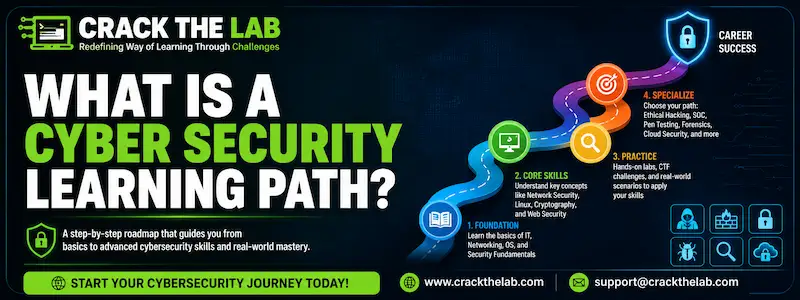 Typically, a good cybersecurity plan consists of:
● Computer and internet basics,
● Networking fundamentals,
● Linux operating system skills,
● Programming and scripting basics,
● Web application security,
● Ethical hacking concepts,
● Vulnerability assessment and penetration testing,
● Defensive security and SOC skills,
● Cyber range practice,
● Projects, certifications, and interview preparation, etc.
An organized cybersecurity learning route assists you in developing abilities in the proper sequence as opposed to acquiring random technologies.
Why is Cybersecurity a Great Career Choice?
Large IT firms are no longer the only ones involved in cybersecurity. Security experts are increasingly needed in almost every industry. To safeguard their websites, networks, apps, cloud infrastructure, databases, and user data, organizations need specialists.
Typical careers in cybersecurity include:
● Ethical Hacker,
● SOC Analyst,
● Penetration Tester,
● Digital Forensics Analyst,
● Malware Analyst,
● Cloud Security Engineer,
● Network Security Engineer,
● Application Security Tester,
● Cyber Security Consultant,
● Threat Intelligence Analyst, etc.
The nice thing is that both beginner and seasoned IT workers can find employment in cybersecurity. Depending on your interests, you can select cloud security, digital forensics, offensive security, defensive security, or governance and compliance.
Step-by-Step Cybersecurity Learning Path for Beginners
1. Start with Computer and Internet Basics
You should comprehend how computers, operating systems, websites, browsers, and the internet operate before studying hacking techniques. These fundamentals aid in your comprehension of how assaults occur and how systems can be safeguarded.
You ought to discover:
● How operating systems work,
● File systems and permissions,
● Browser basics,
● Cookies, sessions, and cache,
● Client-server model,
● Basic command-line usage,
● How websites and web servers communicate, etc.
Because cybersecurity involves more than just using tools, this foundation is crucial. It involves comprehending how systems function and how vulnerabilities are exploited by attackers.
2. Learn Networking Fundamentals
One of the best pillars of cybersecurity is networking. It is challenging to comprehend scanning, exploitation, firewalls, packet analysis, VPNs, DNS assaults, and network monitoring without an understanding of networking.
Key networking subjects consist of:
● IP addressing,
● TCP/IP model,
● OSI model,
● DNS,
● HTTP and HTTPS,
● Ports and protocols,
● Firewalls,
● VPNs,
● Subnetting,
● Routing and switching basics, etc.
Tools like Nmap, Wireshark, Netcat, and traceroute become simpler to use once you understand the fundamentals of networking.
3. Learn Linux Basics
Cybersecurity makes extensive use of Linux. The majority of server settings, cloud systems, security testing platforms, and ethical hacking tools are Linux-based. For this reason, learning Linux is crucial for anyone starting out in cybersecurity.
You should focus on:
● Basic Linux commands,
● File and directory management,
● User and group permissions,
● Process management,
● Package installation,
● Networking commands,
● Bash scripting basics,
● Log file analysis, etc.
Gaining familiarity with environments such as Kali Linux, Ubuntu, and Parrot OS can be facilitated by learning Linux.
4. Understand Programming and Scripting
Although you don't have to be a full-time software developer to begin working in cybersecurity, having a fundamental understanding of programming provides you with a significant advantage. It aids in work automation, malware analysis, vulnerability analysis, and tool customization.
The top programming languages for beginners in cybersecurity:
|
Python |
Ideal for malware analysis, security tools, automation, and scripting. |
|
JavaScript |
Beneficial for browser-based vulnerabilities and online security. |
|
Bash |
Useful for system activities and Linux automation. |
|
SQL |
Crucial for SQL injection testing and database security. |
|
PowerShell |
Helpful for incident response and Windows security. |
Python is the ideal language to start with for the majority of beginners due to its simplicity, strength, and widespread use in cybersecurity.
5. Learn Web Application Security
One of the most well-liked topics in cybersecurity is web application security. Websites, dashboards, portals, APIs, and online apps are used daily by businesses. Attackers frequently target these systems.
Key subjects related to web security include:
● HTTP requests and responses,
● Authentication and authorization,
● Cookies and sessions,
● Input validation,
● SQL injection,
● Cross-site scripting,
● Cross-site request forgery,
● Broken access control,
● File upload vulnerabilities,
● API security,
● OWASP Top 10 vulnerabilities, etc.
Instead of testing live websites without authorization, using authorized cyber labs and cyber range platforms is a safe approach to study web security.
6. Practice Ethical Hacking Legally
Testing systems with the appropriate authorization is known as ethical hacking. It is never advisable for beginners to test unknown IP addresses, corporate networks, or public websites without permission. Unauthorized testing may be dangerous and unlawful.
For safe practice, utilize:
● Cyber range platforms,
● Capture The Flag labs,
● Vulnerable virtual machines,
● Local test environments,
● Authorized training labs,
● Sandbox-based practice environments, etc.
CrackTheLab is really helpful in this situation. It allows students to experience real-world cybersecurity scenarios in a safe and legal setting without endangering actual systems.
7. Learn Vulnerability Assessment and Penetration Testing
VAPT, or vulnerability assessment and penetration testing, is a crucial cybersecurity competency. It assists in locating vulnerabilities, verifying security threats, and creating expert reports.
Typically, VAPT consists of:
● Information gathering,
● Network scanning,
● Service enumeration,
● Vulnerability detection,
● Exploitation in authorized environments,
● Risk analysis,
● Report writing,
● Remediation suggestions, etc.
Common tools used in VAPT include:
● Nmap,
● Burp Suite,
● OWASP ZAP,
● Metasploit,
● Nikto,
● Nessus,
● OpenVAS,
● SQLmap,
● Gobuster,
● Hydra, etc.
Tools are useful, but only if you comprehend the underlying ideas. Both theory and useful tool usage are taught in an effective learning path.
8. Explore Defensive Security and SOC Skills
Hacking is not the only aspect of cybersecurity. Equally crucial is defensive security. To identify and prevent cyberattacks, many firms employ SOC analysts, incident responders, threat hunters, and security monitoring experts.
Topics related to defensive security include:
● SIEM tools,
● Log analysis,
● Malware detection,
● Endpoint security,
● Alert investigation,
● Incident response lifecycle,
● Threat intelligence,
● MITRE ATT&CK framework,
● Phishing email analysis,
● Basic digital forensics, etc.
Both assault and defense should be understood by a competent cybersecurity specialist. This enables you to react like a defender and think like an attacker.
9. Build Real-World Cyber Security Projects
Projects are crucial because they demonstrate your ability to put your knowledge to use. They also assist you in preparing for interviews and boosting your confidence.
Ideas for beginner-friendly cybersecurity projects:
● Use Python to create a simple network scanner.
● Write a script to detect phishing emails.
● Create a log analyzer for Windows or Linux logs.
● Create a password strength checker.
● Make a template for a vulnerability report.
● Establish a local lab for testing online security.
● Practice the Top 10 OWASP vulnerabilities.
● Make a tiny dashboard in the SIEM design.
● Record malware activity in a secure laboratory.
● Create a basic checklist for incident response.
Even if you are new, a good project portfolio can make you stand out.
10. Choose the Right Cybersecurity Certification
Although they can enhance your profile, certifications shouldn't be your exclusive objective. Develop solid foundational knowledge and practical abilities first. Next, select certifications according to your desired professional path.
Well-known cybersecurity certificates consist of:
● CompTIA Security+,
● CEH,
● eJPT,
● PNPT,
● CySA+,
● CHFI,
● OSCP,
● CISSP, etc.
Before pursuing more complex certifications like OSCP or CISSP, it is preferable for beginners to begin with foundational and practical qualifications.
Offensive Security vs Defensive Security
|
Area |
Offensive Security |
Defensive Security |
|
Goal |
Find and exploit weaknesses |
Detect, prevent, and respond to attacks |
|
Common Roles |
Ethical Hacker, Penetration Tester |
SOC Analyst, Blue Team Analyst |
|
Main Focus |
Attack simulation |
Monitoring and response |
|
Practice Method |
Cyber labs, CTFs, exploit testing |
Log analysis, SIEM alerts, incident handling |
Why Hands-On Practice Matters More Than Only Theory
The field of cybersecurity is useful. You can learn concepts by watching videos and reading blogs, but true skill comes from doing.
Practical experience aids in learning:
● How do vulnerabilities actually work?
● What do attackers think?
● How do defenders detect attacks?
● How do tools behave in real scenarios?
● How to troubleshoot errors?
● How to write reports?
● How to handle practical security challenges
Cyber range platforms are useful because of this. They enable students to safely practice in authentic settings.
How CrackTheLab Helps You Start Your Cybersecurity Journey?
One of the top cyber range platforms in India for students seeking hands-on cybersecurity training is CrackTheLab. It offers a hands-on, gamified approach to learning practical cybersecurity skills.
CrackTheLab can help learners with:
|
Feature |
Benefit |
|
Cyber Range Labs |
Practice cybersecurity scenarios from the real world. |
|
Guided Challenges |
Learn by doing rather than speculating. |
|
Gamified Learning |
Remain inspired despite obstacles and advancements. |
|
Practical Skill Building |
Transition from theory to practical experience |
|
Safe Environment |
Practice lawfully without endangering actual systems. |
|
Career-Focused Training |
Get ready for interviews and positions in cybersecurity. |
CrackTheLab assists you in developing the practical skills required to advance in your career as an ethical hacker, SOC analyst, penetration tester, or cybersecurity engineer.
Common Mistakes Beginners Should Avoid
Many beginners squander time by using the incorrect strategy. Your cybersecurity journey can go more smoothly if you avoid these pitfalls.
Typical errors consist of:
● Starting directly with hacking tools without learning the basics,
● Ignoring networking fundamentals,
● Avoiding Linux practice,
● Testing websites without permission,
● Depending only on YouTube videos,
● Chasing certifications without practical skills,
● Learning too many topics at the same time,
● Not taking notes,
● Not building projects,
● Not practicing in cyber labs, etc.
It is better to practice frequently, adhere to a defined plan, and concentrate on practical skills.
Recommended Cybersecurity Roadmap for Beginners
Here is a simple six-month roadmap:
|
Timeline |
Learning Focus |
Practice Goal |
|
Month 1 |
Networking, Linux, internet basics |
Understand ports, protocols, and commands |
|
Month 2 |
Python, Bash, web basics |
Write simple scripts and understand HTTP |
|
Month 3 |
Web security and OWASP Top 10 |
Practice SQLi, XSS, and access control issues |
|
Month 4 |
Ethical hacking tools |
Use Nmap, Burp Suite, and Metasploit safely |
|
Month 5 |
SOC and defensive security |
Analyze logs, alerts, and phishing emails |
|
Month 6 |
Projects and cyber range labs |
Build portfolio and solve real-world labs |
Depending on your learning style and professional objectives, you can modify this plan.
Best Cybersecurity Career Paths for Beginners
You can select a specialization based on your interests once you grasp the fundamentals.
Typical job pathways in cybersecurity include:
● Ethical Hacking: Ideal for students who want to identify weaknesses.
● SOC Analysis: Ideal for students who want to keep an eye on and look into threats.
● Digital Forensics: Ideal for students who want to investigate cybercrimes.
● Malware Analysis: Ideal for students who want to learn about harmful malware.
● Cloud Security: Ideal for students who are interested in cloud infrastructure, AWS, and Azure.
● Web Application Security: Ideal for students who want to test websites and APIs.
● GRC: Ideal for students who are interested in risk, compliance, audits, and regulations.
● Threat Intelligence: Ideal for students who want to monitor cybertrends and attackers.
You don't have to make all of your decisions at once. Learn the basics first, then progressively specialize.
Final Tips to Start Your Cybersecurity Journey
To properly start your cybersecurity journey:
● Prior to using sophisticated technologies, learn the fundamentals.
● Regularly practice networking and Linux.
● Create little projects to put your knowledge to use.
● To practice ethical hacking, use legal cyber laboratories.
● Examine cybersecurity blogs and vulnerability reports.
● Participate in CTF platforms and cybersecurity communities.
● While learning, make notes.
● Prioritize actual skills over certifications.
● Acquire knowledge of both defensive and offensive security.
● Instead of hurrying, practice regularly.
Consistency, curiosity, and hands-on learning are rewarded in cybersecurity.
FAQs
About How to Start Your Cybersecurity Journey with the Right Learning Path
Q. 1: What is the best way to start a cybersecurity journey?
Learning the basics is the best approach to begin your cybersecurity career. Start with computer systems, networking, Linux fundamentals, internet principles, and basic programming. Next, focus on web security, ethical hacking, SOC competencies, and practical cyber range experience. Through hands-on labs and real-world problems, platforms such as CrackTheLab assist beginners in learning cybersecurity.
Q. 2: Why is a cybersecurity learning path important for beginners?
A cybersecurity learning path is crucial because it provides a clear path for beginners. A systematic approach assists students in gradually developing skills rather than absorbing haphazard tools or subjects. Before advancing to more complex fields like penetration testing, digital forensics, cloud security, and incident response, it is essential that you grasp the fundamentals.
Q. 3: Is CrackTheLab good for learning ethical hacking?
Yes, CrackTheLab is a helpful online resource for learning ethical hacking in a secure setting. It assists students in understanding vulnerabilities, solving practical labs, practicing real-world cybersecurity scenarios, and developing practical skills. Students, beginners, IT specialists, and aspiring ethical hackers can all use it.
Q. 4: What skills are required to become a cybersecurity professional?
Learning networking, Linux, programming, web application security, vulnerability assessment, penetration testing, log analysis, SIEM fundamentals, and incident response is necessary to become a cybersecurity specialist. Building a successful cybersecurity profession also requires soft skills like problem-solving, documenting, reporting, and ongoing learning.
Q. 5: Which cybersecurity career path is best for beginners?
For beginners, the ideal job path in cybersecurity depends on their interests. Penetration testing or ethical hacking are wonderful options if you like identifying weaknesses. SOC analysis is a good place to start if you're more interested in monitoring and inquiry. After mastering the basics, beginners can investigate threat intelligence, digital forensics, cloud security, and web application security.
Conclusion
Choosing the appropriate learning path makes it easy to begin your cybersecurity adventure. Start with networking, Linux, programming, web security, ethical hacking fundamentals, defensive security, and practical lab experience rather than learning tools at random.
Since cybersecurity is a skill-based job, real-world experience is more crucial than just theory. While certifications can help your career, practical experience, cyber labs, projects, and problem-solving abilities prepare you for the workforce.
With guided labs, real-world challenges, and a secure legal environment, CrackTheLab—the best cyber range platform in India—assists students in developing practical cybersecurity abilities. CrackTheLab can help you begin your cybersecurity career with confidence and on the proper path, regardless of your background — student, beginner, IT professional, or aspiring ethical hacker. In this regard, users with a full-on wish to practice more on a dedicated cyber range platform in India, such as CrackTheLab, the Best Cyber Range Platform in India. To know more about anything else, call us at +91-9513805401 and ask for all your queries.