Cyber Security
OSINT Explained: How to Gather Intelligence from Public Data?
Pawan PanwarMay 14, 2026
Preparing your workspace...
Loading latest data
Loading article...
Preparing blog content
Do you know what OSINT (Open Source Intelligence) is and how it can help in insight gathering? If not, then you are at the right place. Here, we will talk about OSINT in detail and its best uses.
Moreover, we will introduce you to a reliable Catch The Flag platform offered by a reputable VAPT service provider. What are we waiting for? Let’s get straight to the topic!
The process of gathering and evaluating information from publicly accessible sources, such as social media, public records, and news sources, in order to provide useful insights is known as OSINT, or open-source intelligence.
In contrast to classified espionage, it is based on legally available data that undergoes a thorough filtering and verification process before being converted into intelligence. Cybersecurity experts, journalists, and government organizations use it as a vital tool to recognize risks and comprehend intricate worldwide trends.
Let’s take a look at what OSINT (Open Source Intelligence) is and how it can help in acquiring insights!
|
S.No. |
Factors |
Why? |
|
1. |
Proactive Cybersecurity |
It enables businesses to find compromised credentials and exposed assets before hackers can take advantage of them. |
|
2. |
Democratization of Investigation |
It gives individuals and journalists the ability to use solely public data to unearth truths and hold powerful entities responsible. |
|
3. |
Cost-Effective Intelligence |
Without the enormous financial outlay needed for conventional satellite or human espionage, it offers valuable information. |
|
4. |
Real-Time Situational Awareness |
Through live social feeds, it makes it possible to monitor worldwide events like natural catastrophes or civil unrest as they happen. |
|
5. |
Identifying "Digital Footprints" |
It reveals relationships that were previously obscure by mapping out the public data trail that people and organizations leave behind. |
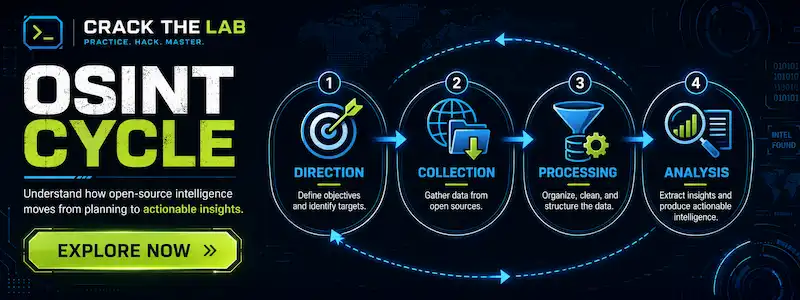
Following is the OSINT Cycle:
The following are some key sources of public data for OSINT:
● Social Media Platforms: To monitor sentiment or movements, public postings, profiles, and geotagged photos from websites such as X, LinkedIn, and Instagram are analyzed.
● Public Records and Government Databases: Obtaining court documents, property records, company filings, and official transcripts to confirm identities and legal histories.
● Websites, Forums, and News Outlets: To obtain in-depth background on particular subjects or niche trends, keep an eye on international news, specialty blogs, and community forums like Reddit.
|
S.No. |
Tools |
What? |
|
1. |
Search Engine Dorking |
Using sophisticated search operators to restrict results and find sensitive directories, secret files, or particular data that search engines have indexed. |
|
2. |
Social Media Intelligence (SOCMINT) |
Monitoring social media platforms for trends, geographical information, and interpersonal relationships using both manual methods and specialist tools. |
|
3. |
WHOIS and DNS Lookups |
Looking at server logs and domain registration information to find the proprietors and technical setup of particular websites. |
|
4. |
Image Forensics |
Identifying a photo's original source, location, and authenticity through reverse image searches and metadata analysis (EXIF data). |
Following is the step-by-step process to gather intelligence from Public Data:
a) Define Objectives: Make sure the search stays focused and compliant by clearly stating what you need to know and why.
b) Identify Sources: Choose the particular websites, databases, and platforms that are most likely to have the necessary data.
c) Harvest Raw Data: To retrieve information from the selected digital environments, use automated tools or manual searching.
d) Validate and Cross-Reference: To make sure the information is correct and not false, compare data from several different sources.
e) Process and Filter: To emphasize the most important information, clean up the gathered data by eliminating noise and duplication.
f) Analyze for Patterns: Analyze the improved data to find patterns, make logical inferences, and connect the dots.
g) Report Findings: Create a structured summary of the analyzed intelligence that gives the end user clear, useful insights.
The following are some legal and ethical considerations in OSINT:
|
S.No. |
Factors |
What? |
|
1. |
Information Overload |
It can be challenging to separate out "noise" and identify pertinent, high-quality intelligence due to the vast amount of data available online. |
|
2. |
Data Reliability and Misinformation |
Publicly accessible data may be purposefully fabricated, skewed, or out-of-date, necessitating thorough verification to prevent erroneous findings. |
|
3. |
Platform Volatility and Access |
OSINT tools and workflows may be abruptly disrupted by social media sites' and databases' frequent changes to their privacy settings, API access, or design. |
|
4. |
The "Mosaic" Effect Risk |
Combining several innocuous public data points can unintentionally expose extremely private or sensitive information, creating serious moral and legal issues. |
|
5. |
Limited Context |
Online raw data frequently lacks context or the "why" behind an event, which could cause misinterpretation in the absence of additional verification. |
Using technological defenses like VPNs, Tor, and virtual machines to conceal your online identity and stop adversaries from monitoring your activities is part of maintaining Operational Security (OPSEC) in OSINT.
You may make sure that your research stays secret and doesn't jeopardize the mission's integrity or your personal security by adhering to stringent "passive" gathering practices and controlling your digital footprint.
1. What is OSINT, and how is it used?
OSINT is the process of gathering and analyzing publicly accessible information from media and the internet to produce useful intelligence for security, research, or investigative purposes.
2. Which tool is commonly used for OSINT?
One of the most popular OSINT tools is Maltego, which specializes in using interactive link-analysis graphs to map out relationships between individuals, companies, and digital infrastructure.
3. What is OSINT in cybercrime?
Threat actors utilize OSINT in cybercrime to perform reconnaissance on targets, gathering public information such as software versions, employee names, and email trends to create extremely successful phishing attacks or take advantage of certain technical flaws.
4. What are the three types of OSINT?
The following are the three types of OSINT:
a) Human-Centric OSINT (SOCMINT),
b) Technical OSINT, and
c) Media and Geospatial OSINT (GEOINT).
5. What are the techniques used in OSINT gathering?
The following techniques are used in OSINT gathering:
a) Advanced Search Engine Dorking,
b) Metadata & Image Analysis,
c) Social Graph & Username Pivoting,
d) Technical Infrastructure Mapping, and
e) Dark Web & Breach Monitoring.
6. Which type of intelligence is gathered from publicly available sources?
The following types of intelligence are gathered from publicly available sources:
a) Social Media Intelligence (SOCMINT),
b) Geospatial Intelligence (GEOINT),
c) Technical Intelligence (TECHINT),
d) Media Intelligence, and
e) Public Record Intelligence.
7. What are the 4 types of CTI?
The following are the 4 types of CTI:
a) Strategic Intelligence,
b) Tactical Intelligence,
c) Operational Intelligence, and
d) Technical Intelligence.
8. How to gather intelligence information?
In the following ways, you can gather intelligence information:
a) Requirement Planning,
b) Source Identification,
c) Data Harvesting,
d) Verification and Triangulation, and
e) Contextual Analysis.
9. What are the 7 common methods of gathering information?
The following are the 7 common methods of gathering information:
a) Open-Source Intelligence (OSINT),
b) Human Intelligence (HUMINT),
c) Technical Scanning & Enumeration,
d) Surveys and Questionnaires,
e) Physical Observation,
f) Signals Intelligence (SIGINT), and
g) Database and Archive Research.
10. What are the three types of OSINT?
The following are the three types of OSINT:
a) SOCMINT (Social Media Intelligence),
b) Technical OSINT, and
c) GEOINT (Geospatial Intelligence).
Now that we have talked about what OSINT (Open Source Intelligence) is, you might want to test your cybersecurity as well. For that, you can go for Crack The Lab, a dedicated Catch The Flag platform offered by Craw Security.
There, you can test your cybersecurity skills as a defender while securing a dummy website against the offensive team. Moreover, your skills will grow more and more while practicing them on this platform. What are you waiting for? Contact, Now!