Cyber Security
Top 10 User Authentication Tools and Software in 2026
Pawan PanwarMay 14, 2026
Preparing your workspace...
Loading latest data
Loading article...
Preparing blog content
Do you know what User Authentication Tools are capable of? If not, then you are at the right place. Here, we will talk about the Top 10 User Authentication Tools and Software in 2026 that can come in handy to protect your confidential information against online threats.
Moreover, we will introduce you to a reliable Catch The Flag platform offered by a reputable VAPT service provider. What are we waiting for? Let’s get straight to the topic!
User authentication software is a digital security framework meant to validate the identification of individuals or systems seeking to access a network, application, or device. To guarantee that only authorized users are able to enter, it serves as a gatekeeper by comparing supplied credentials, such as passwords, biometrics, or security tokens, with recorded data.
In order to deliver a smooth and extremely secure user experience, these tools will depend more and more on "passwordless" technologies and behavioral analytics in 2026. Let’s take a look at what are the Top 10 User Authentication Tools and Software in 2026!
Static, weak passwords have given way to "passwordless" ecosystems where device-bound passkeys and cryptographic FIDO2 protocols are used to verify identification. The shift to "invisible" security in 2026, where AI-driven behavioral biometrics and adaptive risk scoring continuously authenticate people based on their distinct interaction patterns without interfering with their workflow, defines this advancement.
|
S.No. |
Factors |
Why? |
|
1. |
Combatting AI-Powered Phishing and Deepfakes |
Advanced authentication prevents extremely convincing, AI-generated identity fraud by using cryptographic keys and "liveness" tests. |
|
2. |
The Shift to Zero Trust Architecture |
As the "new perimeter," authentication mandates that all access requests be validated, independent of the user's location. |
|
3. |
Preventing MFA Fatigue and "Prompt Bombing" |
These days, "invisible" behavioral checks that verify users without constant interruption take the place of obtrusive push-notification spam. |
|
4. |
Stricter Global Regulatory Compliance |
In order to safeguard sensitive consumer and business data, new data rules from 2026 require "phishing-resistant" authentication, such as FIDO2. |
|
5. |
Rise of Decentralized Identity (DID) |
Users can now own their digital credentials thanks to authentication, which lowers the possibility of large-scale, centralized "honey-pot" data breaches. |
The following are some of the security & compliance standards:
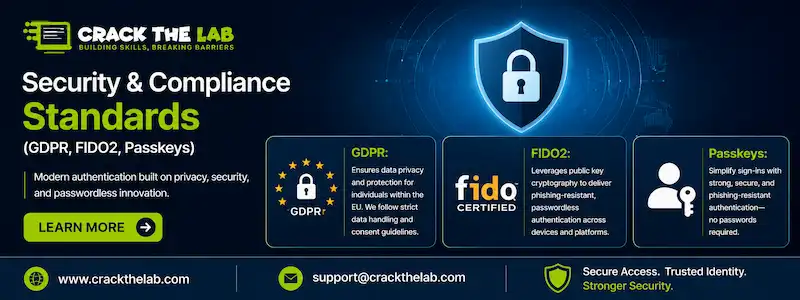
● GDPR: Mandates "Data Protection by Design" and stipulates that biometric templates or authentication logs must be strictly controlled by users and never kept for longer than is necessary.
● FIDO2: An open standard that ensures private keys are safe from remote assaults and never leave the user's device by substituting public-key cryptography for passwords.
● Passkeys: FIDO2's user-friendly implementation, which enables users to sign in using biometrics or device PINs, offers a smooth, extremely secure, and phishing-resistant experience across platforms.
The following are the key features to look for in User Authentication Tools:
a) Phishing-Resistant Passwordless Support: Ensures that cryptographic keys never leave the hardware by using FIDO2 and device-bound passkeys, preventing credential theft.
b) AI-Powered Adaptive Authentication: Only dynamically increases protection when a login seems dangerous by analyzing real-time signals such as location, time, and device health.
c) Continuous Behavioral Biometrics: Passively keeps an eye on distinctive user behaviors, including mouse movement and typing speed, to confirm identity over the course of the session.
d) Decentralized Identity (DID) Integration: Reduces the need for businesses to maintain sensitive personal information by enabling consumers to hold their own verifiable credentials in digital wallets.
e) Just-in-Time (JIT) & Ephemeral Access: Elevated privileges are only granted for a predetermined task and period of time, and they are automatically revoked to remove "standing" security threats.
|
S.No. |
Roles |
What? |
|
1. |
Continuous Behavioral Verification |
Ensures that the original user is still behind the screen by passively monitoring distinctive typing patterns and touch pressure. |
|
2. |
AI-Powered Liveness Detection |
Quickly prevents high-resolution photo spoofing and artificial "deepfake" video by analyzing skin texture, pulse, and light reflection. |
|
3. |
Adaptive Risk Scoring |
Before allowing access, a real-time "trust score" based on location, device health, and time of day is computed using machine learning. |
|
4. |
Non-Human Identity Management (KYA) |
Uses "Know Your Agent" techniques to confirm that automated scripts and AI bots are approved by a certified person. |
|
5. |
Privacy-Preserving Biometrics |
Uses on-device "local-only" processing and decentralized models to confirm identity without ever keeping private raw data in a central database. |
The following are the Top 10 User Authentication Tools and Software in 2026:
a) Features of Okta:
● Okta FastPass,
● Adaptive MFA with AI,
● Identity Governance & Administration (IGA),
● Okta for AI Agents, and
● Identity Security Posture Management (ISPM).
a) Features of Microsoft Entra ID:
● Conditional Access with Real-Time Risk,
● Microsoft Entra Agent ID,
● Phishing-Resistant Passkeys,
● Global Secure Access (SSE), and
● Verified ID Face Check.
a) Features of Cisco Duo:
● Duo Passport,
● Agent Identity Management,
● Duo Passwordless (FIDO2/ Passkeys),
● Cisco Identity Intelligence, and
● Continuous Risk-Based Monitoring.
a) Features of Ping Identity:
● PingOne DaVinci (No-Code Orchestration),
● Identity for AI (Agent IAM),
● Zero-Knowledge Biometrics (Keyless),
● Advanced API Security, and
● Verifiable Credentials (Decentralized Identity).
a) Features of CyberArk:
● Secure Web Sessions,
● Machine Identity Security (MIS),
● AI-Powered Adaptive MFA,
● Zero Standing Privilege (ZSP), and
● AI Agent Governance.
a) Features of Auth0:
● Auth0 for AI Agents,
● Universal Login with Progressive Profiling,
● Auth0 Actions & Forms,
● Fine-Grained Authorization (FGA), and
● Identity Threat Protection with AI.
a) Features of OneLogin:
● SmartFactor Authentication,
● Non-Human Identity Protection,
● HR-Driven Identity Lifecycle,
● OneLogin Desktop, and
● Shield Phishing Protection.
a) Features of IBM Security Verify:
● AI-Powered Threat-Based Blocking,
● Agentic IAM & Delegation,
● Seamless Passwordless (FIDO2 & QR),
● IBM Application Gateway, and
● External Consent Orchestration.
a) Features of JumpCloud:
● Agentic IAM & AI Discovery,
● Unified Device & Identity Management,
● JumpCloud Go™ (Phishing-Resistant Auth),
● Zero Trust Conditional Access, and
● Cloud RADIUS & LDAP.
a) Features of LoginRadius:
● Agentic IAM & Delegated Authority,
● Progressive Profiling & Unified Personas,
● AI-Driven Adaptive MFA,
● Global Privacy & Compliance Cloud, and
● No-Code Identity Orchestration.
In the following ways, you can choose the right user authentication software:
● Assess Security Risk & Compliance: Make sure the platform complies with regional data residency regulations for your particular business and requires phishing-resistant FIDO2/Passkeys.
● Evaluate "Agentic" Readiness: To verify, control, and audit the autonomous AI agents engaging with your systems, select a tool with a specific framework.
● Prioritize Adaptive & Behavioral UX: Seek out "invisible" security that reduces user friction while preserving ongoing verification through AI-driven risk assessment.
● Verify Integration & Scalability: Verify that the program can manage huge login spikes and has deep native hooks for your current stack (such as Microsoft 365 and AWS).
● Analyze Total Cost of Ownership (TCO): Consider implementation expenses, ongoing maintenance, and the possible "risk tax" of a breach in addition to the seat price.
|
S.No. |
Trends |
What? |
|
1. |
Agentic IAM (Know Your Agent) |
Gives autonomous AI bots unique cryptographic identities and "intent boundaries" so they can safely act on behalf of people. |
|
2. |
Behavioral Biometrics as a Constant |
Continually verifies identity during a session by passively observing distinctive user behaviors like typing rhythm and swipe curvature. |
|
3. |
Widespread "Wallet-First" Decentralized Identity |
Ends the use of centralized "honey-pot" databases by enabling users to store their own verifiable credentials (such as digital IDs) in secure phone wallets. |
|
4. |
Transition to Post-Quantum Cryptography (PQC) |
incorporates "quantum-safe" algorithms into authentication processes to prevent powerful quantum computers from decrypting long-term data in the future. |
|
5. |
Phishing-Resistant "Synchronized" Passkeys |
Substitutes synchronized, device-bound cryptographic keys for conventional passwords, making it nearly hard for hackers to steal credentials. |
1. What is the best authentication tool?
The "best" tool depends totally on your ecosystem: Cisco Duo is the greatest option for quick, easy MFA implementation, Okta is the best option for neutral, multi-cloud SaaS estates, and Microsoft Entra ID is the best option for Microsoft-centric settings.
2. Which IAM tool is best?
Because of its extensive integration network and its AI-driven "agentic" workflow governance, Okta continues to be the best overall IAM product for neutral, cloud-first corporations in 2026, while Microsoft Entra ID is the best option for businesses with significant investments in the Windows and Azure ecosystem.
3. What are the 4 pillars of IAM?
The following are the 4 pillars of IAM:
a) Administration,
b) Authentication (AuthN),
c) Authorization (AuthZ), and
d) Auditing and Governance.
4. What are the 4 types of MFA?
The following are the 4 types of MFA:
a) Something You Know (Knowledge),
b) Something You Have (Possession),
c) Something You Are (Inherence), and
d) Somewhere You Are (Location/ Context).
5. What are authentication tools?
Before allowing users, devices, or AI agents access to digital resources, authentication tools are software programs and protocols created to confirm their identities.
6. What are the five types of authentication?
The following are the five types of authentication:
a) Knowledge (Something You Know),
b) Possession (Something You Have),
c) Inherence (Something You Are),
d) Location (Somewhere You Are), and
e) Behavior (Something You Do).
7. Which is better, SSO or MFA?
Because they fulfill different purposes, neither is "better": MFA (Multi-Factor Authentication) offers security by requiring additional verification steps to establish your identity, while SSO (Single Sign-On) offers ease by enabling a single login for all apps.
8. What are the 7 API authentication methods and examples?
The following are the 7 API authentication methods:
a) API Keys,
b) OAuth 2.0,
c) JWT (JSON Web Tokens),
d) Basic Authentication,
e) mTLS (Mutual TLS),
f) HMAC (Hash-Based Message Authentication Code), and
g) OpenID Connect (OIDC).
Now that we have talked about the Top 10 User Authentication Tools and Software in 2026, you might want to test your cybersecurity skills professionally. For that, you can go for Crack The Lab, a dedicated Catch The Flag offered by Craw Security.
Moreover, you will become a defender and will be given the responsibility to protect it against the rival team, who are offenders with your cybersecurity skills. What are you waiting for? Contact, Now!