Cyber Security
10 Best Ethical Hacking Tools with Brief Features
Pawan PanwarMay 8, 2026
Preparing your workspace...
Loading latest data
Loading article...
Preparing blog content
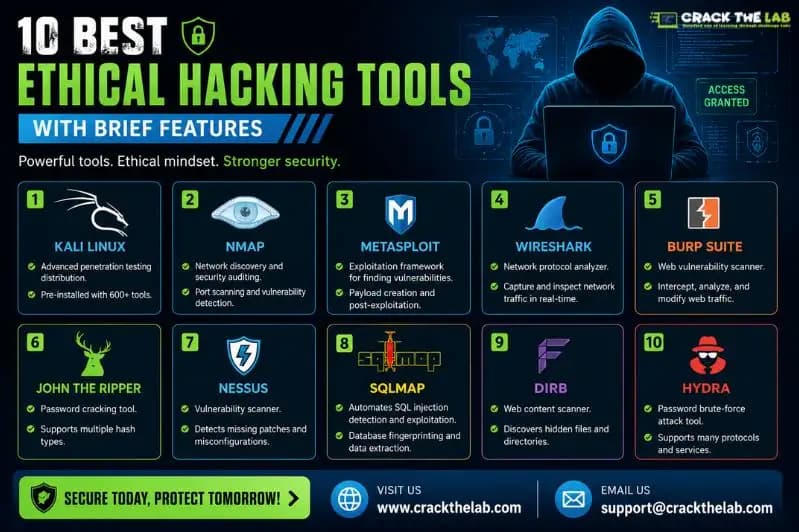
Do you know what Ethical Hacking Tools are and how they can be useful in protecting confidential data against online threats? If not, then you are at the right place. Here, we will talk about Ethical Hacking Tools in detail and their best use.
Moreover, we will introduce you to a reliable Catch The Flag platform offered by a reputable VAPT service provider. What are we waiting for? Let’s get straight to the topic!
Specialized software programs and scripts created to find weaknesses, evaluate security threats, and evaluate the robustness of digital infrastructures are known as ethical hacking tools.
They give cybersecurity experts the same tools that bad actors employ, such as network scanning, password cracking, and packet sniffing, but they are used lawfully to fortify defenses. These solutions enable companies to repair vulnerabilities before they may be exploited by proactively identifying flaws like obsolete software or incorrect configurations. Let’s take a look at what Ethical Hacking Tools are and their uses!
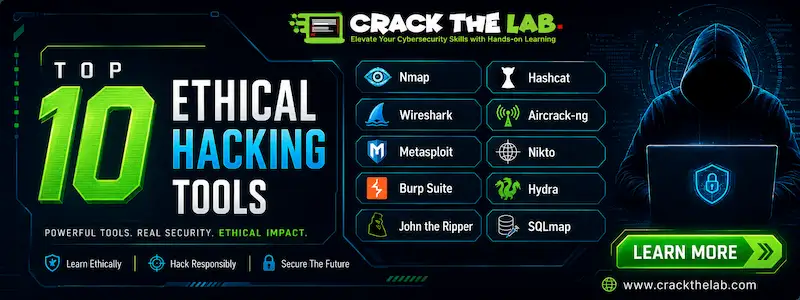
The following are some of the Top 10 Ethical Hacking Tools:
1. Invicti: An automated online application security scanner called Invicti is made to find flaws in large-scale systems, such as SQL injection and Cross-Site Scripting (XSS). It uses a special "Proof-Based Scanning" method to automatically validate vulnerabilities found, greatly lowering false positives and freeing up security professionals to concentrate on real threats.
a) Features of Invicti:
● Proof-Based Scanning™,
● Combined DAST + IAST,
● Continuous Asset Discovery,
● Advanced API Security, and
● SDLC and CI/CD Integration.
2. Fortify WebInspect: An enterprise-grade dynamic application security testing (DAST) tool called Fortify WebInspect (by OpenText, previously Micro Focus) mimics actual assaults to find weaknesses in web services and applications.
It is renowned for its profound integration with the Fortify ecosystem and its capacity to deliver code-level insights via hybrid testing.
a) Features of Fortify WebInspect:
● Vulnerability Verification (Attack Validation),
● Hybrid DAST + IAST,
● Comprehensive Asset Discovery,
● Advanced API Security, and
● SDLC and CI/ CD Integration.
3. Cain & Abel: A traditional password recovery and security auditing program created especially for Microsoft Windows operating systems is called Cain & Abel. Security experts mostly use it to find flaws in network setups and authentication protocols using a variety of cryptography and sniffer methods.
a) Features of Cain & Abel:
● Network Sniffing,
● Password Cracking,
● ARP Poisoning,
● VoIP Recording, and
● Routing Protocol Analysis.
4. Nessus: Security experts utilize Nessus, a thorough vulnerability assessment tool created by Tenable, to find, look into, and rank security threats across a wide variety of IT assets.
Because of its extensive library of constantly updated plugins and its great accuracy in identifying misconfigurations and unpatched software, it is widely regarded as the industry standard for vulnerability scanning.
a) Features of Nessus:
● Comprehensive Vulnerability Scanning,
● Credentialed & Agent-Based Scanning,
● Configuration & Compliance Auditing,
● External Attack Surface Management (EASM), and
● Advanced Web & Cloud Security.
5. Nikto: Nikto is a well-known open-source web server scanner that runs thorough checks on web servers to find potentially harmful files, out-of-date server software, and configuration errors.
Nikto is intended to be a quick, high-volume reconnaissance tool that "noises up" a target to find surface-level vulnerabilities, in contrast to scanners that concentrate on intricate application logic.
a) Features of Nikto:
● Extensive Vulnerability Database,
● Server Misconfiguration Detection,
● IDS Evasion Techniques,
● Subdomain and Virtual Host Support, and
● Pluggable and Updated Architecture.
6. Intruder: Intruder is a cloud-based vulnerability management tool that offers automated, continuous scanning of both internal and external assets to make digital infrastructure protection easier.
It provides prioritized findings that indicate real-world vulnerabilities across cloud environments, online applications, and endpoints, serving as an intuitive link between sophisticated security technologies and lean teams.
a) Features of Intruder:
● Continuous Attack Surface Monitoring,
● Emerging Threat Scans,
● Smart Risk Prioritization,
● Cloud Security Connectors, and
● Compliance Automation.
7. Netsparker: The enterprise-grade web application security scanner Netsparker, which has since changed its name to Invicti, was the first to use automated exploitation to confirm vulnerabilities.
It is specifically made to assist big businesses in managing the security of thousands of websites and APIs by offering extremely precise, "dead-accurate" answers that don't need to be manually verified.
a) Features of Netsparker:
● Proof-Based Scanning™,
● Combined DAST + IAST,
● Asset Discovery & Inventory,
● Enterprise Scalability, and
● Full SDLC Integration.
8. Metasploit: The most popular penetration testing framework in the world, Metasploit (created by Rapid7), offers security teams a robust environment for creating, testing, and running exploit code.
It functions as a single platform that converts manual attack methods into automated modules, enabling experts to confirm vulnerabilities and evaluate the practical consequences of such breaches.
a) Features of Metasploit:
● Modular Exploit Library,
● Payload and Shellcode Selection,
● Vulnerability Scanner Integration,
● Post-Exploitation Modules, and
● Msfvenom Payload Generator.
9. Aircrack-Ng: With an emphasis on monitoring, attacking, testing, and cracking, Aircrack-ng is a full suite of expert-grade tools for evaluating WiFi network security. It is the industry standard for recovering wireless keys and finding flaws in 802.11 implementation, and it functions mostly via the command line, enabling extensive scripting and automation.
a) Features of Aircrack-Ng:
● Packet Monitoring,
● Packet Injection & Attacks,
● WEP and WPA/WPA2 Cracking,
● Wireless Card Management, and
● Advanced Decryption & Tunneling.
10. Nmap (Network Mapper): The industry standard for mapping digital infrastructures is Nmap (Network Mapper), a potent, open-source tool for network discovery and security audits.
To find out which hosts are online, what services they are providing, and what operating systems they are running, it sends raw IP packets to a network.
a) Features of Nmap (Network Mapper):
● Host Discovery,
● Port Scanning,
● Service and Version Detection,
● OS Fingerprinting, and
● Nmap Scripting Engine (NSE).
The following are some legal and ethical frameworks:
● Explicit Authorization (Written Consent): To provide legal protection, a written, signed agreement must be obtained before beginning any testing.
● Defined Scope and Rules of Engagement (RoE): To prevent interfering with vital business processes, closely adhere to predetermined goals and deadlines.
● The "Do No Harm" Principle: Put system stability first by preventing harmful exploits and making sure users can continue to use services.
● Confidentiality and Data Protection: Consider all information and vulnerabilities that are found to be extremely sensitive, and make sure they are handled and stored safely.
● Responsible Disclosure: Provide the client with clear remedy instructions and promptly and exclusively report all results.
|
S.No. |
Factors |
Why? |
|
1. |
Proactive Vulnerability Identification |
They enable security teams to find unpatched software, misconfigurations, and "zero-day" exploits before malevolent hackers do. |
|
2. |
Risk Assessment and Prioritization |
By measuring the severity of security flaws, these tools enable organizations to focus their limited resources on the most serious risks. |
|
3. |
Regulatory Compliance |
To safeguard sensitive customer data, numerous frameworks (including PCI-DSS, HIPAA, and GDPR) require routine security testing and vulnerability scanning. |
|
4. |
Network Resilience Testing |
Tools assist in confirming whether current security mechanisms (firewalls, WAFs) truly function as intended by mimicking real-world assaults like DDoS or SQL injection. |
|
5. |
Cost-Effective Prevention |
Dealing with the legal fees, lost revenue, and brand harm that come with a successful data breach is far more expensive than finding and resolving a flaw during a normal scan. |
Now that we have talked about what Ethical Hacking Tools are and how you can use them to protect your confidential data, you might want to know where you can use your ethical hacking knowledge and skills.
For that, you can go for Crack The Lab, a dedicated Catch The Flag platform offered by Craw Security. Users will be able to use their ethical hacking skills to protect the website that will be provided to them on this platform against the rival team. What are you waiting for? Contact, Now!