Cyber Security
How to Start a Career in Cybersecurity (2026 Roadmap)?
Pawan PanwarMay 5, 2026
Preparing your workspace...
Loading latest data
Loading article...
Preparing blog content
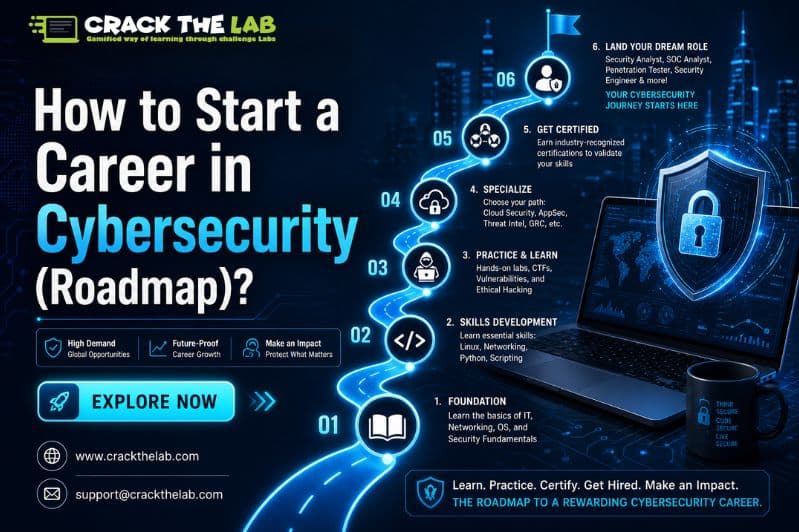
Do you want to know how you can start a Career in Cybersecurity? If yes, then you are at the right place. Here, we will talk about the things you need to know before starting a career in the cybersecurity domain in the IT Industry.
Moreover, we introduce you to a reliable Catch The Flag platform offered by a reputable VAPT service provider. What are we waiting for? Let’s get started!
Protecting linked systems, networks, devices, and sensitive data from online threats, theft, or illegal access is known as cybersecurity. It includes a variety of procedures, technologies, and controls intended to guarantee the availability, confidentiality, and integrity of digital data.

Organizations and individuals can reduce risks and protect their assets from the constantly changing world of cyber threats by putting in place layered defenses. Let’s talk about how you can Start a Career in Cybersecurity!
|
S.No. |
Factors |
Why? |
|
1. |
Unmatched Job Demand |
As businesses try to guard against increasingly complex and automated cyber threats, the worldwide talent shortage continues to be a major concern. |
|
2. |
Competitive Earning Potential |
Because of their unique skill set and high demand, cybersecurity specialists can earn premium wages that are frequently significantly more than industry averages. |
|
3. |
Meaningful and Impactful Work |
Professionals are essential in preventing real-world harm to crucial infrastructure, public safety, and individual privacy. |
|
4. |
Continuous Learning and Innovation |
The field is never stationary because of the threat landscape's continuous evolution, which presents countless problems to be solved. |
|
5. |
Diverse Career Path Variety |
There are many specializations in the sector, such as governance, cloud security, digital forensics, and ethical hacking, which enable tailored career advancement. |
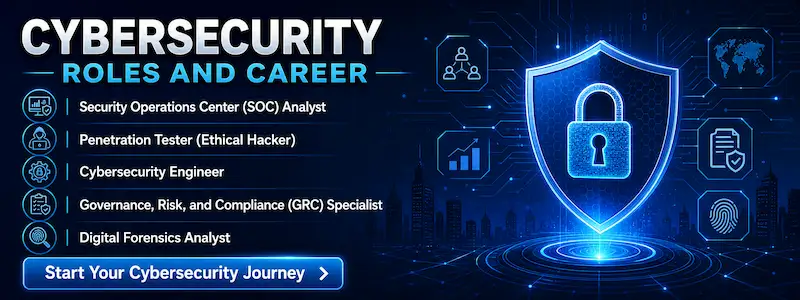
The following are some of the key cybersecurity roles and career paths explained:
You need the following skills to get started:
● Fundamentals of Networking: You need to comprehend how data moves over the internet, including the OSI model, TCP/IP, DNS, and HTTP/S protocols.
● Operating Systems Proficiency: Both system defense and forensic analysis require a thorough understanding of Linux (command line) and Windows system administration.
● Scripting and Programming: To automate security chores and analyze malware, one must be able to read and write code in languages like Python, Bash, or PowerShell.
● Security Concepts and Frameworks: A strong understanding of fundamental concepts, including standard frameworks like NIST or MITRE ATT&CK and the CIA triad (Confidentiality, Integrity, Availability).
● Analytical Problem Solving: The capacity to adopt an attacker's perspective to spot possible vulnerabilities and handle difficult, abstract security problems with a methodical, evidence-based approach.
|
S.No. |
Skills |
Why? |
|
1. |
Effective Communication |
For non-technical stakeholders and executive leadership, you must be able to convert complicated, technical security issues into understandable, practical business language. |
|
2. |
Continuous Adaptability |
A growth mentality that supports ongoing learning and the quick adoption of new tools and techniques is necessary since the threat landscape is constantly changing. |
|
3. |
Ethical Integrity |
Because working in cybersecurity gives you access to extremely sensitive data, a steadfast dedication to professional ethics and legal standards is crucial. |
|
4. |
Critical Thinking |
During a security crisis, you have to make critical judgments under extreme time pressure, connect seemingly unconnected warnings, and analyze unclear scenarios. |
|
5. |
Collaborative Teamwork |
To successfully deploy defense tactics, you must be able to collaborate across IT, legal, and operational divisions. Security is a team effort. |
The following are the Top Cybersecurity Certifications for Beginners:
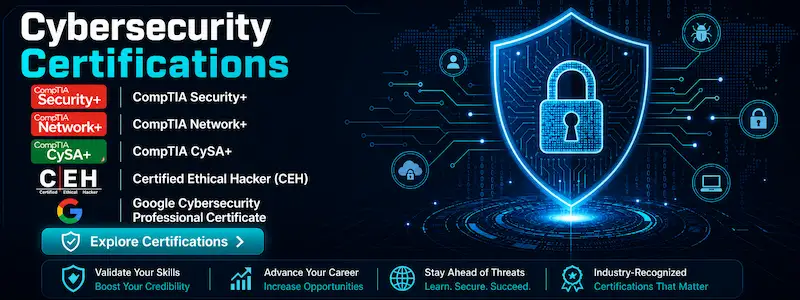
a) CompTIA Security+: The industry-standard foundational certification that attests to the fundamental abilities required to carry out essential security tasks and seek a career in IT security.
b) CompTIA Network+: Establishes the fundamental understanding of network architecture, protocols, and troubleshooting needed to comprehend the infrastructure that needs to be secured.
c) CompTIA CySA+: A mid-level certification that teaches you how to proactively identify and mitigate network threats with an emphasis on behavioral analytics and incident response.
d) Certified Ethical Hacker (CEH): Gives experts a practical insight into the instruments and techniques employed by malevolent actors, allowing them to spot weaknesses from the viewpoint of an attacker.
e) Google Cybersecurity Professional Certificate: An introductory program that prepares students for real-world security duties through hands-on, modular training while offering job-ready skills in Python, Linux, and SQL.
Gaining practical experience is crucial for bridging the gap between academic understanding and practical application, enabling you to advance your technical proficiency in a safe setting.
Platforms like CrackTheLab, Hack The Box, and competitive Capture The Flag (CTF) events should be your top priorities if you want to practice spotting weaknesses and putting defensive plans into action against hypothetical attackers.
|
S.No. |
Steps |
What? |
|
1. |
Build a Foundational Knowledge Base |
Learn the fundamentals of networking, OS administration (Windows/ Linux), and fundamental security principles, including the CIA trinity. |
|
2. |
Obtain Industry-Recognized Certifications |
Obtain entry-level certifications, such as CompTIA Security+, to demonstrate your abilities and go beyond preliminary HR checks. |
|
3. |
Gain Practical, Hands-On Experience |
To develop technical proficiency in a practical, risk-free setting, make use of resources like CrackTheLab and CTF challenges. |
|
4. |
Develop a Specialized Focus |
Choose a specialty, like incident response, penetration testing, or cloud security, to match your education with in-demand occupations. |
|
5. |
Cultivate a Professional Network and Portfolio |
Post project documentation on GitHub or your own website, and interact with the security community to identify employment openings. |
One of the best online courses available for cybersecurity skills is the 1 Year Cyber Security Diploma Course in Delhi, powered by AI, offered by Craw Security. This amazing course clears your doubts about the 12 fundamentals of cybersecurity with the latest techniques and tools.
Moreover, during the training, you will be facilitated with interactive sessions, Virtual Labs, latest cybersecurity techniques and tools. Moreover, after completing the training and exams, you will receive a dedicated certificate validating your honed knowledge & skills. Let’s move forward!
In the following ways, you can create a strong cybersecurity resume and portfolio:
Focus your job search on high-volume operational positions that emphasize monitoring and triage over specialized architecture, such as IT Security Technician, Junior Information Security Analyst, or Level 1 SOC Analyst, in order to land an entry-level position.
To get past application tracking systems and highlight your real-world lab and CTF project experience, use LinkedIn's professional networks, focus on companies with Security Operations Centers (SOCs), and match your résumé with job-specific keywords.
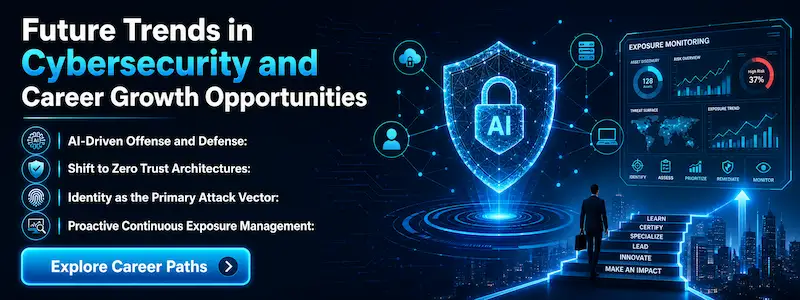
The following are the future trends in cybersecurity and career growth opportunities:
● AI-Driven Offense and Defense: AI speeds up real-time, autonomous threat detection and response capabilities as well as automated attack generation.
● Shift to Zero Trust Architectures: Traditional perimeters are being replaced with a "never trust, always verify" approach for all network access in organizations.
● Identity as the Primary Attack Vector: Securing digital identities has emerged as the most crucial frontier against illegal access as static perimeters disappear.
● Proactive Continuous Exposure Management: In order to find and fix vulnerabilities before they are exploited, security teams are moving from periodic scans to continuous visibility.
● Increasing Regulatory and Compliance Oversight: Professionals with expertise in risk management, auditing, and governance are in great demand due to stricter international data protection regulations.
About Start a Career in Cybersecurity
1. How should I start my cybersecurity career?
In the following ways, you can start your cybersecurity career:
a) Master Foundational IT Knowledge,
b) Earn Industry-Recognized Certifications,
c) Gain Hands-On Practical Experience,
d) Develop a Professional Portfolio, and
e) Network Within the Security Community.
2. What is an L1, L2, L3 SOC analyst?
A Level 2 (L2) Analyst investigates and contains escalated threats in-depth, a Level 3 (L3) Analyst serves as a senior hunter and incident responder, performing advanced forensics, threat hunting, and remediation strategy development, and a Level 1 (L1) Analyst handles initial triage and monitoring of security alerts.
3. Can I start a career in cybersecurity with no experience?
By developing a solid foundation in IT, obtaining entry-level certifications like CompTIA Security+, and showcasing your abilities through practical labs and projects, you may definitely begin a career in cybersecurity without any prior experience.
4. Is 25 too late for cybersecurity?
No, 25 is not too late at all; in fact, career pivots into cybersecurity are frequently made at this age because the industry places a high emphasis on your professional maturity, technological curiosity, and problem-solving abilities.
5. Will AI replace cybersecurity?
AI won't take the position of cybersecurity experts; rather, it will revolutionize the industry by automating repetitive operations, freeing up human specialists to concentrate on high-level planning, intricate threat hunting, and the moral judgment needed to handle increasingly complex AI-driven attacks.
6. What are the 7 types of cybersecurity?
The following are the 7 types of cybersecurity:
a) Network Security,
b) Application Security,
c) Information Security (InfoSec),
d) Cloud Security,
e) Endpoint Security,
f) Operational Security (OpSec), and
g) Disaster Recovery and Business Continuity.
7. Which 3 jobs will survive AI?
The following are the 3 jobs that will survive AI:
a) Security Architect,
b) Incident Response Manager, and
c) Threat Hunter.
8. Which Big 4 is best for cybersecurity?
The following are the Big 4 best for cybersecurity
a) Deloitte,
b) PwC,
c) EY, and
d) KPMG.
9. Is cybersecurity a dying field?
No, cybersecurity is not a dying field; rather, it is one of the most important and rapidly expanding industries in the world economy. This is because there is a long-term, pressing need for qualified experts who can secure intricate digital infrastructures due to the emergence of AI-driven threats and growing regulatory requirements.
Now that we have talked about starting a Career in Cybersecurity, you might want to get reliable training resources for best practices & learning experiences. For that, you can get in contact with Craw Security, offering a 1-Year Cyber Security Diploma Course.
Moreover, those who are beginners or have some experience in cybersecurity can go for CrackTheLab, a dedicated Catch The Flag platform also offered by Craw Security. This platform sorts participants into 2 teams, Red Team & Blue Team.
One of these teams will be defenders, and the other one will be offenders. They will be handed over a vulnerable website. One party will try to exploit it, and the second party will try their best to defend it against the rival team. What are you waiting for? Contact, Now!