Cyber Security
Latest OWASP Top 10 Updates Explained (2026 Guide)
Pawan PanwarMay 6, 2026
Preparing your workspace...
Loading latest data
Loading article...
Preparing blog content
Do you know what OWASP Top 10 is and how it can help cybersecurity practitioners working in the IT Industry? If not, then you are at the right place. Here, we will find out about what to expect from OWASP and the beneficial factors.
Moreover, we will introduce you to a reliable Catch The Flag platform offered by a reputable VAPT service provider. What are we waiting for? Let’s get started!
A nonprofit organization called OWASP (Open Worldwide Application Security Project) works as an open community with the goal of enhancing software security through community-led open-source initiatives.
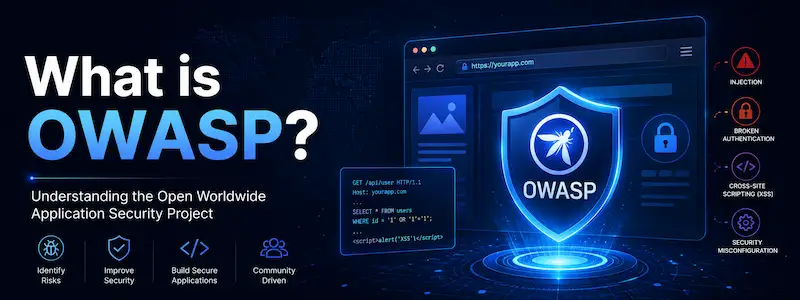
Its most well-known product is the OWASP Top 10, a frequently updated report that helps firms prioritize their protection strategy by listing the most important web application security threats. It sets the industry standard for developers and security experts to create, acquire, and maintain reliable applications by offering free tools, documentation, and international conferences. Let’s take a look at what OWASP Top 10 is, and its benefits to the users!
The following are some of the missions of OWASP:
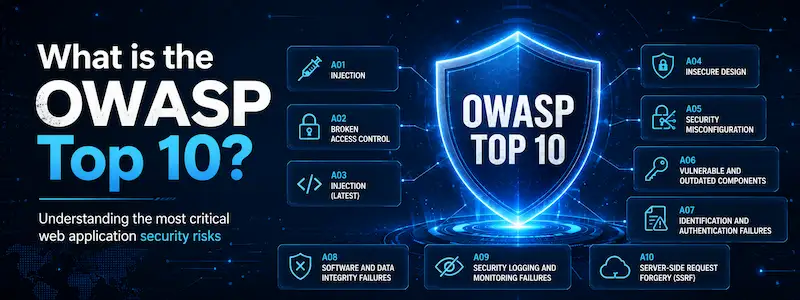
Based on agreement among security experts, the OWASP Top 10 is an internationally known awareness document that identifies the most serious security threats to online applications. It acts as a fundamental road map for companies to include proactive protection measures in their software development lifecycles and prioritize vulnerabilities.
|
S.No. |
Topics |
Factors |
What? |
|
1. |
Data-Driven Analysis |
Empirical Evidence |
Depends on hard data collected from traffic logs, bug bounty requests, and vulnerability databases. |
|
Quantitative Metrics |
Evaluates the technical seriousness and frequency of particular defects using scoring systems such as CVSS. |
||
|
Objective Identifying |
Eliminates human bias by concentrating only on what occurs in the wild across millions of applications. |
||
|
Trend Prediction |
Forecasts new threat trends using statistical modeling based on past attack spikes. |
||
|
Scalability |
Enables the automatic scanning and analysis of large datasets that are too big for humans to examine by hand. |
||
|
2. |
Community Consensus |
Contextual Insight |
Takes into consideration "exploitability" and "business impact" that raw data could miss in some sectors. |
|
Expert Intuition |
Captures the collective "gut feeling" of seasoned researchers about risks that are challenging to identify or automate. |
||
|
Qualitative Value |
Focuses on the "why" of a threat, taking into account complicated logical errors and human behavior. |
||
|
Future-Proofing |
Finds "low-frequency but high-impact" threats that experts know are disastrous, but data may overlook. |
||
|
Actionable Strategy |
Converts complicated data into easily understood, high-level recommendations that businesses can truly apply on a large scale. |
The following are the security risks reported in the OWASP Top 10 2021 Report:
● Broken Access Control: Failure to impose limitations on the actions of authenticated users.
● Cryptographic Failures: Sensitive data is not adequately protected both in transit and at rest, which frequently results in data exposure.
● Injection: Unauthorized command execution or data access is caused by hostile data provided to an interpreter.
● Insecure Design: Architectural design flaws that cannot be resolved by flawless execution.
● Security Misconfiguration: Hardware or software configurations that are not appropriately secured, including unsecured cloud storage or default accounts.
● Vulnerable and Outdated Components: Utilizing software components that have known security flaws that are simple for attackers to take advantage of.
● Identification and Authentication Failures: Vulnerabilities in user identity verification that let hackers take over sessions or accounts.
● Software and Data Integrity Failures: Unable to prevent unauthorized modifications to data or code during processing or updating.
● Security Logging and Monitoring Failures: Incapacity to quickly identify, report, or address active security breaches.
● Server-Side Request Forgery: Vulnerabilities that give an attacker the ability to compel a server-side program to send HTTP requests to unauthorized domains.
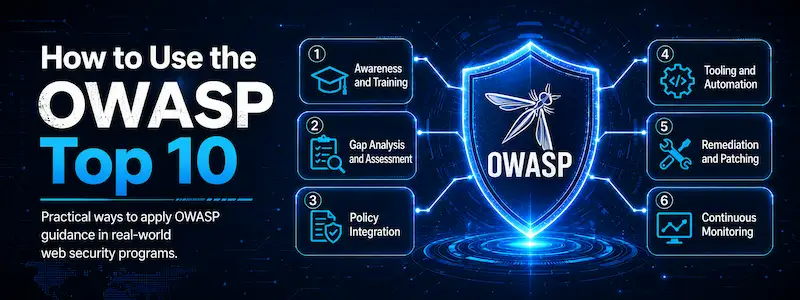
In the following ways, you can use the OWASP Top 10:
a) Awareness and Training: To guarantee that security is a common language throughout the team, inform developers and stakeholders about the particular threats mentioned.
b) Gap Analysis and Assessment: To determine whether vulnerabilities (such as Broken Access Control or Injection) are now present in your code, audit your current applications against the Top 10.
c) Policy Integration: Modify your Software Development Life Cycle (SDLC) to incorporate coding standards and required security tests that target these ten risk categories.
d) Tooling and Automation: Install SAST (Static Analysis) and DAST (Dynamic Analysis) tools that are set up to automatically identify the top ten vulnerabilities while the build is underway.
e) Remediation and Patching: Fixing found defects should be prioritized according to their impact, with "Insecure Design" at the architectural level and "Vulnerable Components" at the library level receiving special attention.
f) Continuous Monitoring: Create reliable logging and warning systems to quickly identify attempts to exploit these vulnerabilities.
Now that we have talked about what OWASP Top 10 is, you might want to test your knowledge & skills on a reliable platform. For that, you can go for Crack The Lab, a dedicated Catch The Flag offered by Craw Security.
This platform gives you the opportunity to team up and fight against the rival team in the form of defender and offender. You can also take it as Red Team and Blue Team. Moreover, it’ll be a good practical experience for the practitioners. What are you waiting for? Contact, Now!
About OWASP Top 10
1. What is OWASP Top 10, and why is it used?
The OWASP Top 10 is a widely accepted consensus document that helps organizations prioritize vulnerabilities and create better secure software by identifying the most important online application security concerns.
2. What does OWASP stand for?
The Open Worldwide Application Security Project, or OWASP for short, is a nonprofit organization devoted to enhancing software security.
3. What is OWASP Top 10 in 2026?
The redesigned 2025/2026 edition of the OWASP Top 10 for 2026 incorporates a contemporary shift toward protecting software supply chains and agentic AI systems while combining more conventional dangers like SSRF into more general categories like Broken Access Control.
4. What are the top 3 items in the OWASP Top 10?
The following are the top 3 items in the OWASP Top 10:
a) Broken Access Control,
b) Cryptographic Failures, and
c) Injection.
5. How to use OWASP Top 10?
In the following ways, you can use OWASP Top 10:
a) Training and Culture,
b) Secure Coding Standards,
c) Application Security Testing,
d) Risk Assessment, and
e) Procurement and Compliance.
6. What is the OWASP Top 10 for AI?
In order to assist developers in protecting AI-integrated systems, the OWASP Top 10 for AI (more precisely, the OWASP Top 10 for LLM Applications) is a customized framework that highlights the most serious security flaws particular to generative AI, namely Prompt Injection and Training Data Poisoning.
7. What are some OWASP tools?
The following are some OWASP tools:
a) OWASP ZAP (Zed Attack Proxy),
b) OWASP Dependency-Check,
c) OWASP Amass,
d) OWASP SAMM (Software Assurance Maturity Model),
e) OWASP ModSecurity Core Rule Set (CRS).
8. What is an OWASP vulnerability?
An OWASP vulnerability is a specific security defect or weakness in a software program that falls into one of the high-risk areas that the OWASP community has determined are most important for web and API security.
9. Is OWASP a government organization?
No, OWASP is not a government institution or organization; rather, it is an open community and a worldwide nonprofit foundation.
10. Is OWASP free?
Although voluntary paid memberships are offered to support the foundation, all OWASP tools, documentation, and project resources are free and open-source for everyone to use.