Education
Prompt Engineering Techniques: A Practical Guide for AI Users
Pawan PanwarMay 10, 2026
Preparing your workspace...
Loading latest data
Loading article...
Preparing blog content
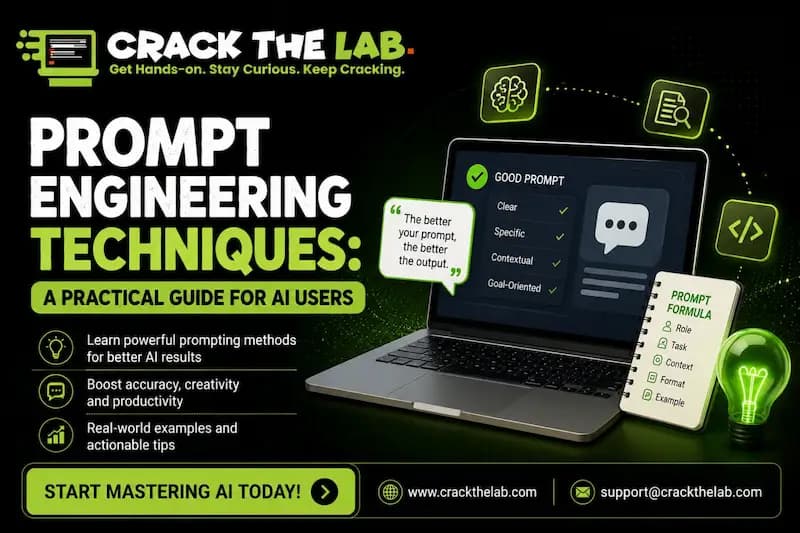
Do you want to know what Prompt Engineering Techniques are and how they are used for better task management? If yes, then you are at the right place. Here, we will talk about what Prompt Engineering is in detail to get a better understanding of its fundamentals.
Moreover, we will introduce you to a reliable Catch The Flag platform offered by a reputable VAPT service provider. What are we waiting for? Let’s get straight to the topic!
The deliberate process of fine-tuning and optimizing inputs to large language models (LLMs) in order to direct them toward producing more precise, pertinent, and superior outputs is known as prompt engineering.
It entails comprehending the subtleties of a model's language interpretation, such as the application of certain personas, limitations, and contextual instances, like few-shot prompting. By becoming proficient in these methods, users can greatly lessen hallucinations and fully utilize generative AI's capacity for problem-solving.
Let’s take a look at what Prompt Engineering Techniques are and how they work for better AI tasks handling!
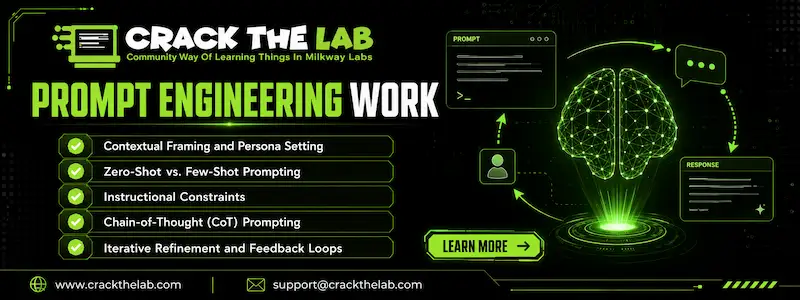
In the following ways, Prompt Engineering works:
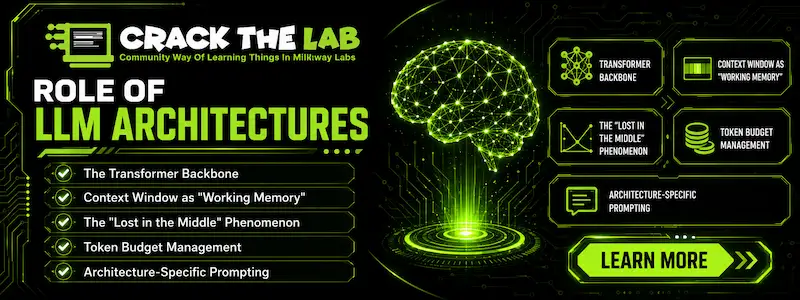
The following are the roles of LLM Architectures and context windows:
● The Transformer Backbone: Determines how the model interprets your cue by using self-attention mechanisms to assess the significance of various words in a sequence.
● Context Window as "Working Memory": Specifies how many tokens a model may "remember" and analyze simultaneously in a single discussion.
● The "Lost in the Middle" Phenomenon: A drawback in which models successfully comprehend the start and finish of a prompt but find it difficult to remember details that are buried in the middle.
● Token Budget Management: The process of striking a balance between the amount of space available and the specific instructions to keep the model from forgetting or cutting out earlier information.
● Architecture-Specific Prompting: Improving instruction following by customizing input formats to fit a model's particular training (e.g., utilizing specific tags like [INST] or <|system|>).
|
S.No. |
List |
What? |
|
1. |
Zero-Shot Prompting |
Requesting that the model complete a task without including any training data or previous examples in the input. |
|
2. |
Few-Shot Prompting |
Providing a brief collection of excellent examples to illustrate the precise structure or reasoning the model should adhere to. |
|
3. |
Chain-of-Thought Prompting |
Giving the model instructions to "think step-by-step" will help it perform better on challenging mathematics or reasoning tasks. |
|
4. |
Role-Based Prompting |
Establishing the competence and tone of the response by giving the AI a specific identity (such as "Act as a Senior Cybersecurity Analyst"). |
|
5. |
Instruction-Based Prompting |
Giving clear, unambiguous instructions and limitations (such as "Summarize in 50 words") to regulate the output's format and content. |
The following are some of the latest prompt engineering techniques for 2026:
a) Multi-Step Prompting: To ensure accuracy, complex procedures are broken down into a series of connected prompts where each output feeds the next.
b) Self-Consistency Prompting: To get rid of hallucinations, generate several lines of reasoning for the same question and choose the most consistent response.
c) Retrieval-Augmented Prompting: The AI is grounded in current, true reality by dynamically infusing real-time data from vector databases or APIs straight into the prompt.
d) Structured Prompt Templates: To improve model parsing, rigorously define sections like <context>, <rules>, and <examples> using XML elements or JSON schemas.
The following are some of the prompt engineering tips for better AI results:
The methodical process of testing, evaluating, and adjusting quick variables to reduce errors and improve output quality over time is known as iterative refinement. Teams can monitor performance changes across various model upgrades by implementing prompt version control using tools like Git or specific AI playgrounds.
This enables them to roll back to "known good" versions and preserve consistency in production situations.
The following are some of the factors that prove the importance of prompt engineering skills:
● Maximizing Productivity and Efficiency: Eliminates laborious editing and automates intricate operations by producing the intended result on the first try.
● Mitigating AI Hallucinations: Uses grounding strategies and logical restrictions to make sure the model produces accurate, verifiable data.
● Cost Optimization for Enterprises: Minimizes token usage and API expenses by crafting succinct, effective instructions that steer clear of pointless repetition.
● Bridging the Technical-Creative Gap: Allows non-technical individuals to operate complex AI systems with normal language instead of complicated code.
● Future-Proofing Your Career: Creates a fundamental talent for the AI-driven economy, where "AI orchestration" is turning into a necessary professional competency.
Transitioning from casual conversation to "prompt programming," which entails understanding organized frameworks like Chain-of-Thought and Retrieval-Augmented Generation (RAG), is necessary to become industry-ready in prompt engineering.
Additionally, it necessitates a thorough comprehension of operational skills, including cost-effective token management inside enterprise-scale AI pipelines, automated fast evaluation, and A/B testing across several model versions.
|
S.No. |
Job Profiles |
Salaries |
|
1. |
Prompt Engineer/ AI Interaction Designer |
₹40,000 - ₹3,50,000+/ month |
|
2. |
AI Solutions Architect |
₹1,18,000 - ₹2,60,000/ month |
|
3. |
Natural Language Processing (NLP) Specialist |
₹50,000 - ₹2,00,000+/ month |
|
4. |
AI Content Strategist/ Copywriter |
₹25,000 - ₹1,50,000+/ month. |
|
5. |
AI Ethics and Compliance Officer |
₹40,000 - ₹4,00,000+/ month |
The following are some AI Ethics and Bias Mitigation in Prompting:
a) Counter-Stereotypical Prompting: Inherent training biases can be countered by explicitly telling the model to steer clear of popular clichés or offer a variety of viewpoints.
b) Red Teaming through Adversarial Prompts: To find and fix security holes and harmful output triggers, the model is purposefully tested using "jailbreak" or "injection" prompts.
c) Objective and Neutral Constraints: Establishing stringent guidelines that demand that the AI give factual, evidence-based responses rather than speculative or subjective ones.
d) Auditability and Transparency: Keeping a "prompt log" to monitor the factors that influenced certain choices, guaranteeing responsibility for outcomes produced by AI.
e) Bias Detection Frameworks: Before the primary AI output reaches the end user, it is scanned for linguistic bias or discriminatory language using supplementary "evaluator" prompts.
About Prompt Engineering Techniques
1. What is prompt engineering?
The strategic technique of creating and improving inputs to direct AI models toward generating precise, excellent, and contextually appropriate outcomes is known as prompt engineering.
2. What are prompt engineering techniques?
Specialized language tactics like Few-Shot, Chain-of-Thought, and Role-Based prompting are examples of prompt engineering techniques that are designed to enhance an AI's accuracy, reasoning, and format.
3. How does prompt engineering work?
In the following ways, prompt engineering works:
a) Contextual Grounding,
b) Logical Structuring,
c) Example-Based Learning,
d) Step-by-Step Reasoning, and
e) Iterative Refinement.
4. What are some practical prompt engineering tips?
The following are some practical prompt engineering tips:
a) Assign a Specific Persona,
b) Use Delimiters for Clarity,
c) Specify the Desired Output Format,
d) Implement Negative Constraints,
e) Provide Reference Text.
5. Is it beneficial for an AI professional to pursue a certification in prompt engineering?
Yes, AI experts can formalize their proficiency in model orchestration, guarantee consistent enterprise-grade outputs, and demonstrate mastery of the most crucial "soft-technical" competence in the generative AI era by obtaining a quick engineering certification.
Now that we have talked about what Prompt Engineering Techniques are, you might want to test your cybersecurity skills on a dedicated platform. For that, you can go for Crack The Lab, a dedicated Catch The Flag platform offered by Craw Security.
This amazing platform gives the experience of a cybersecurity arena where two teams get one website and become defender & offender. There, one team will do everything to exploit the website, take unauthorized access, and another team will be blocking that unauthorized attempt to protect the website. What are you waiting for? Contact, Now!