Education
Top 10 OSINT Tools Hackers Need to Know About
Pawan PanwarApr 7, 2026
Preparing your workspace...
Loading latest data
Loading article...
Preparing blog content
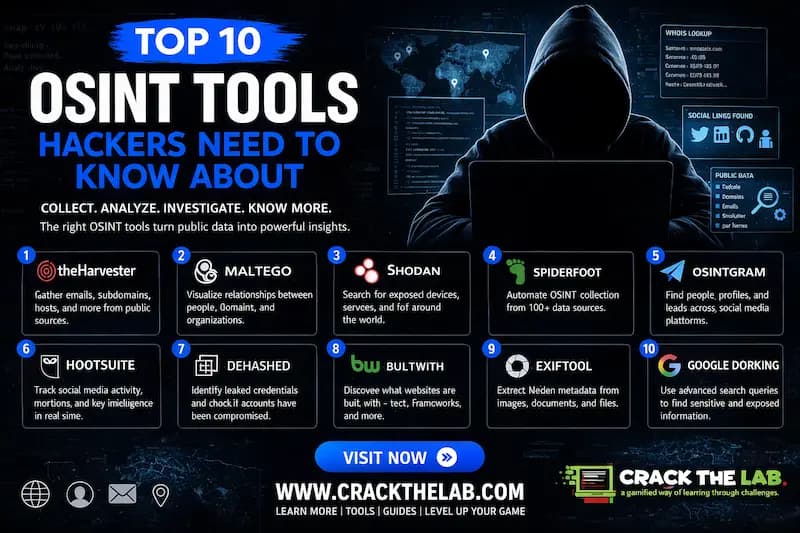
Do you want to learn about the 10 OSINT Tools Hackers Need to Know About? If yes, then you are at the right place. Here, we will explore those amazing OSINT Tools that today’s hackers really need to know about.
Moreover, we will introduce you to a reliable cybersecurity training ground offer an opportunity to use your hacking skills efficiently & effectively. What are we waiting for? Let’s get started!
Software programs or platforms known as Open Source Intelligence (OSINT) technologies are used to gather, examine, and display publicly accessible data from a variety of sources, including social media, news websites, public databases, and the dark web.
These technologies enable cybersecurity experts, investigators, and researchers to map linkages, spot possible dangers, and obtain actionable insights without having to deal with the target directly by automating the aggregation and processing of this massive, unclassified data. In the end, they greatly speed up danger hunting and risk assessment by converting dispersed, unstructured data into organized intelligence. Let’s take a look at the 10 OSINT Tools Hackers Need to Know About and their uses!
The following are the Top 10 OSINT Tools Hackers Need to Know About:
1.Shodan:

An internet-connected device search engine that enables hackers to find exposed industrial control systems, IoT hardware, and susceptible servers.
2. Maltego:

An interactive graph-based link analysis tool that maps connections between IP addresses, domains, individuals, and digital infrastructure.
3. Google Dorks:

A collection of sophisticated search operators that use Google's indexing to locate sensitive directory listings, exposed credentials, and hidden configuration files.
4. Recon-ng:
A robust, modular web-based reconnaissance framework that automates data collecting during the footprinting stage and resembles Metasploit in appearance and feel.
5. TheHarvester:
An application created especially to collect names, IP addresses, subdomains, and emails from public sources such as PGP key servers and search engines.
6. SpiderFoot:
An automated tool that does deep, correlation-based reconnaissance on an IP or domain by integrating with more than 100 public data sources.
7. OSINT Framework:

A thorough, categorized website that helps with organized intelligence gathering by arranging different tools and methods into a logical structure.
8. WayBack Machine:
 A digital archive that gives hackers access to earlier iterations of websites, possibly exposing deleted pages or critical information that has been exposed.
9. Social Searcher:

A social media search engine that tracks trends or profiles people by keeping an eye on public posts and real-time mentions on many platforms.
10. TinEye:

A reverse image search engine that assists in locating the original source or usage of photos to confirm their legitimacy or reveal hidden internet personas.
Strong Operational Security (OpSec) during OSINT necessitates isolating your research environment via VPNs, hardened browsers, and dedicated, non-attributed virtual computers to avoid unintentionally revealing your true identity or location.
You can reduce your digital trace and make sure that your research efforts do not unintentionally notify the target of your existence by removing metadata from downloaded files, using "burner" accounts for social media reconnaissance, and directing traffic through proxy chains.
You must conduct thorough subdomain enumeration using programs like subfinder or gather to detect misconfigured DNS records that frequently act as entry points, neglected staging environments, and shadow IT in order to guarantee a thorough security posture.
This "attack surface mapping" guarantees that your BDR and EDR policies are executed uniformly across all digital assets, preventing subdomain takeovers and leaving no blind spots for an enemy to exploit.
In order to automatically find assets and identify changes in real-time, the reconnaissance procedure can be automated by chaining modular tools like Recon-ng or SpiderFoot into a continuous CI/CD pipeline.
Security teams can switch from manual point-in-time snapshots to a persistent, automated map of their worldwide threat surface by using custom scripts or orchestrators to feed data into centralized dashboards.
Now that we have talked about the 10 OSINT Tools Hackers Need to Know About, you might want to get to know them in detail under the supervision of professionals. If yes, then you are at the right place.
You can go for Crack The Lab, offered by Craw Security, a reputed cybersecurity training firm. This tool offers you a battleground where you can test your skills against fire malware with the latest cybersecurity tools, including OSINT Tools. What are you waiting for? Contact, Now!
Helpful Resources