Best Cyber Range Platform in the World

Do you know what the Best Cyber Range Platform in the World is? Here, we will talk about what a cyber range platform is and how it can help in enhancing your cybersecurity knowledge & skills.
Moreover, we will introduce you to a reputed training institute offering a dedicated cyber range practice platform. What are we waiting for? Let’s get straight to the topic!
What is a Cyber Range Platform?
Security teams can practice defensive tactics, incident response, and threat hunting in a secure, controlled environment by using a Cyber Range Platform, an advanced virtualized environment created to mimic actual IT and OT networks.
These platforms enable enterprises to test their security technologies, check setups, and perform realistic "live-fire" exercises against simulated adversary strategies by building high-fidelity digital replicas of enterprise architectures.
In the end, they greatly shorten the time needed to identify and eliminate real threats by acting as a vital link between theoretical cybersecurity understanding and operational preparedness. Let’s take a look at the Best Cyber Range Platform in the World and see what kind of benefits there are for users!
Types of Cyber Range Platforms
The following are the types of cyber range platforms:
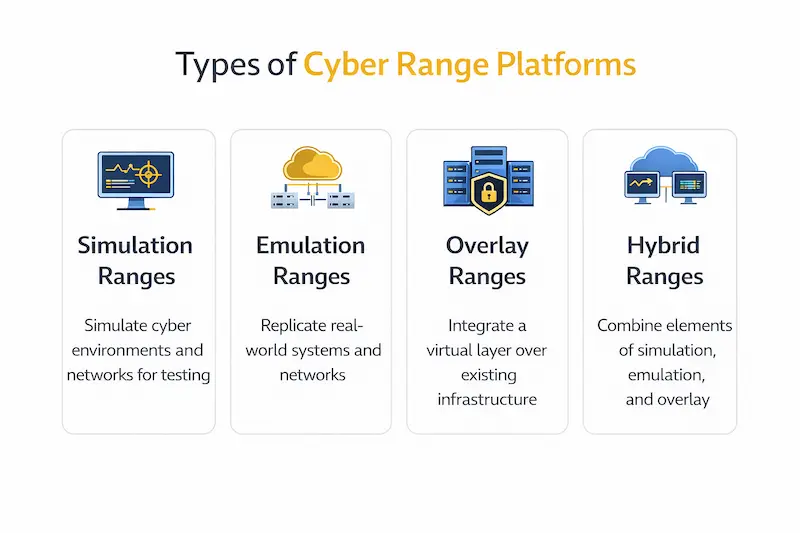 Simulation Ranges: These are very scalable and affordable, making them ideal for basic training and conceptual learning. They use software to mathematically model and recreate network dynamics and attack scenarios.
- Emulation Ranges: These are perfect for advanced security testing and red team exercises because they provide a high-fidelity environment that operates exactly like a production system by using physical or extremely precise virtual hardware to mimic particular network configurations.
- Overlay Ranges: By overlaying virtual components or simulated attacks on top of an organization's current live network infrastructure, these platforms enable testing in a true production setting without necessitating a full rebuild.
- Hybrid Ranges: These are the most adaptable kind, combining aspects of simulation, emulation, and overlay. Depending on the particular requirements of the exercise or test, these allow businesses to balance cost, resource efficiency, and extreme realism.
Why Cyber Range Platforms Are in High Demand Globally?
For the following reasons, cyber range platforms are in high demand globally:
● Addressing the Critical Cybersecurity Skills Gap: Beyond theoretical learning, cyber ranges offer practical, realistic "live-fire" training that speeds up the development of workforce skills.
● Escalating Sophistication of Global Threats: In order to keep ahead of quickly changing attack vectors, these systems enable teams to safely experience and analyze sophisticated, automated adversarial techniques.
● Regulatory Pressure and Compliance Requirements: Only high-fidelity cyber ranges can reliably provide the stringent, evidence-based security testing and personnel proficiency audits that regulators are increasingly requiring.
● Safe Validation of Security Infrastructure: Without jeopardizing the reliability of the production environment, organizations use these controlled environments to stress-test new security technologies and system settings against actual threats.
● Need for Collaborative Incident Response (IR) Rehearsals: They provide team-based, cross-functional simulation exercises that close the gaps in workflow and communication that are frequently revealed during high-stress, real-world security breaches.
Cyber Range vs Traditional Training: Key Differences
|
S.No. |
Topics |
Factors |
What? |
|
1. |
Cyber Range Training |
Dynamic & Experiential |
Focuses on "live-fire" exercises in which participants actively defend against changing, real-time attacks in a high-fidelity network replica. |
|
Outcome-Focused |
Prioritizes quantifiable performance indicators to verify operational preparedness, such as Mean Time to Detect (MTTD) and Mean Time to Respond (MTTR). |
||
|
High Realism |
Enables the testing of proprietary tools and particular organizational setups by offering a sandbox environment that replicates intricate, enterprise-grade infrastructures. |
||
|
2. |
Traditional Training |
Static & Theoretical |
Depends on lectures, PowerPoint shows, or prepackaged online courses that provide fundamental knowledge but don't include practical, active application. |
|
Assessment-Focused |
Primarily uses knowledge-based tests or certification examinations to gauge learning, which frequently don't show how a user would behave under real circumstances. |
||
|
Generic Content |
Uses lab settings or generalized scenarios that aren't customized to the organization's unique software, network architecture, or business hazards. |
Key Features of the Best Cyber Range Platform in the World
The following are the key features of the best cyber range platform in the world:
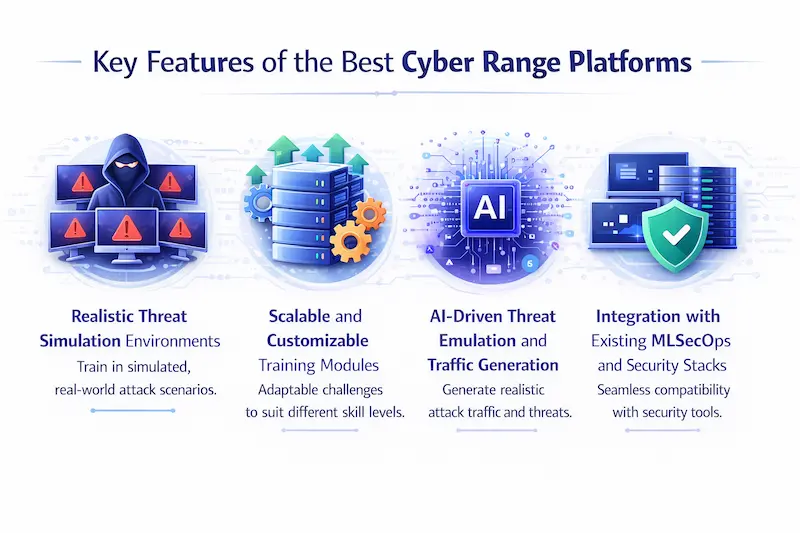
a) High-Fidelity Digital Twins: They build precise virtual copies of a company's unique network infrastructure, including custom configurations, IoT devices, and actual operating systems.
b) AI-Driven Threat Emulation: They simulate sophisticated human or machine-speed enemies by using autonomous AI agents to conduct dynamic, non-linear attacks that change depending on the defender's actions.
c) Comprehensive Traffic Generation: They provide realistic background noise to evaluate a defender's capacity to identify anomalies by simulating thousands of concurrent "normal" user activities, such as email and web browsing.
d) Measurable Readiness Analytics: They measure certain indicators like Mean Time to Detect (MTTD) and individual skill-gap analysis for compliance, and they offer detailed, data-driven reporting on team performance.
e) Integrated Collaborative Orchestration: With its automated "one-click" deployment and reset features, attacking (Red) and defensive (Blue) teams can work together in shared Purple Teaming activities with ease.
Role of Digital Twins and High-Fidelity Environments
Security teams may test fixes and simulate attacks without running the risk of operational outage thanks to digital twins and high-fidelity environments, which function as perfect virtual clones of an organization's distinct production network.
They guarantee that the skills trained and the vulnerabilities found are directly applicable to the real environment defenders are safeguarding by simulating real-world settings, hardware, and traffic patterns.
AI-Driven Threat Emulation and Traffic Generation
AI-driven threat emulation makes sure security teams are ready for adaptive attacks by using autonomous agents to imitate complex, multi-stage adversary behaviors that change in real-time, dependent on defensive reactions.
At the same time, defenders can practice differentiating true anomalies from normal operating traffic by using high-fidelity traffic creation, which produces realistic, artificial network background noise that mimics legitimate user activity.
Top Use Cases of Cyber Range Platforms
The following are the top use cases of the cyber range platforms:
- SOC and Incident Response (IR) Readiness: Cyber ranges are used by Security Operations Center teams to perform high-stress, "live-fire" drills that verify their internal playbooks, communication procedures, and ability to quickly identify and neutralize simulated active breaches.
- Security Tool Validation and Configuration: Before implementing these tools in production, organizations use these environments to stress-test new security technologies, firewall rules, and endpoint detection setups against the most recent threat intelligence.
- Purple Teaming and Threat Hunting: Cyber ranges offer the ideal environment for cooperative exercises in which the Blue Team simultaneously practices active hunting, detection, and mitigation procedures in real-time while the Red Team launches sophisticated, multi-stage attacks.
Purple Teaming and Collaborative Crisis Rehearsal
In order to find security flaws and improve detection logic, offensive and defensive teams collaborate in real time in a unified training environment made possible by Purple Teaming and Collaborative Crisis Rehearsal.
By practicing cross-departmental crisis communication and response procedures, this cooperative strategy enables businesses to make sure that all stakeholders are ready for the high-pressure demands of a real-world breach.
Benefits of Using a Cyber Range Platform
|
S.No. |
Benefits |
How? |
|
1. |
Risk-Free Environment |
Offers a secure sandbox where complicated threats and novel configurations can be tested without running the risk of upsetting the stability of the real network. |
|
2. |
Accelerated Skill Development |
Allows for practical, intense training that significantly shortens the time needed for analysts to achieve operational proficiency. |
|
3. |
Objective Readiness Measurement |
Provides data-driven performance measures to measure team effectiveness and pinpoint specific training gaps, such as MTTD and MTTR. |
|
4. |
Enhanced Tool Optimization |
Enables businesses to maximize return on investment by stress-testing security product settings and detection logic against actual threat patterns. |
|
5. |
Improved Incident Response (IR) Coordination |
Facilitates cooperative, cross-functional exercises that synchronize decision-making and communication processes in realistic high-pressure situations. |
Measuring ROI through Readiness Metrics (MTTD/MTTR)
Quantifying the decrease in Mean Time to Detect (MTTD) and Mean Time to Respond (MTTR) attained by regular cyber range exercises is part of measuring ROI using readiness metrics. Organizations can clearly illustrate improvements in operational efficiency by monitoring these performance benchmarks, which effectively justifies the expenditure by demonstrating a decrease in the potential financial loss from actual security incidents.
How to Choose the Best Cyber Range Platform?
By considering the following factors, you can choose the best cyber range platform:
● Align Fidelity with Your Threat Profile: Make sure the environment closely resembles the vital assets and vulnerabilities you need to safeguard by choosing a platform that is as complicated as your particular design.
● Prioritize Integration and Ecosystem Compatibility: To verify actual operational procedures, make sure the platform easily integrates with your current security stack, including SIEM, SOAR, and EDR technologies.
● Evaluate Scenario Customization and Content Freshness: Select a system that makes it simple to create unique scenarios and offers frequent content updates to stay up to speed with newly developed adversarial strategies.
● Assess Analytics and Actionable Readiness Metrics: Seek out solutions that provide comprehensive, measurable reporting on team performance so you can transform training data into understandable, practical enhancements for your security posture.
● Consider Deployment Scalability and Support: To optimize long-term usefulness, confirm that the infrastructure can grow to the size of your company and that the vendor offers strong technical support and community resources.
Integration with Existing MLSecOps and Security Stacks
A smooth feedback loop where cyber range observations directly affect the tweaking of automated detection models and incident response orchestration is made possible by integration with current MLSecOps and security stacks.
You may assess security playbooks and retrain machine learning models against the most recent high-fidelity attack data without affecting live operations by connecting the range to your production SIEM, SOAR, and AI-governance tools.
Future Trends in Cyber Range Technology
The following are the future trends in cyber range technology:
a) Agentic AI-Driven Attack and Defense Ecosystems: Cyber ranges will increasingly include autonomous AI agents that can launch multi-stage, adaptive attacks and carry out defensive countermeasures.
This will enable teams to train against threats that change in real time without the need for human intervention.
b) Continuous Exposure Management (CEM) Integration: In order to ensure that training environments consistently represent an organization's current, live-attack surface, future platforms will interface with continuous exposure monitoring systems to automatically ingest real-world vulnerability information, going beyond periodic testing.
c) Post-Quantum Cryptographic Readiness Simulations: Cyber ranges will develop specific modules to mimic the effects of quantum-based attacks on existing encryption standards as quantum computing develops.
This will allow enterprises to stress-test their transition to post-quantum cryptography in a secure setting.
Frequently Asked Questions
About the Best Cyber Range Platform in the World
1. What is a cyber range platform?
Security teams can do practical training, verify security technologies, and practice incident response against developing cyber threats in a secure, controlled environment by using a cyber range platform, a virtualized, high-fidelity environment created to mimic real-world IT and OT networks.
2. Why is a cyber range important for cybersecurity training?
Cyber range is important for cybersecurity training for the following reasons:
a) Hands-On "Live-Fire" Experience,
b) Safe Sandbox for Failure,
c) Rehearsal of Complex Incident Response,
d) Validation of Skills Under Stress, and
e) Performance-Based Metrics.
3. Who can use a cyber range platform?
The following individuals can use a cyber range platform:
a) Security Operations Center (SOC) Teams,
b) Red and Blue Teaming Groups,
c) Government and Military Agencies,
d) Corporate Enterprises, and
e) Academic and Research Institutions.
4. What skills can I learn from a cyber range?
One can learn the following skills from a cyber range:
a) Advanced Threat Detection and Analysis,
b) Incident Response (IR) and Forensics,
c) Security Tool Configuration and Management,
d) Offensive Security and Adversary Emulation, and
e) Collaborative Crisis Communication.
5. Is a cyber range suitable for beginners?
Yes, because they frequently feature guided, scaffolded scenarios that offer instant feedback and lead you through fundamental security concepts in a risk-free environment, modern cyber ranges are ideal for novices.
6. How does a cyber range simulate real-world attacks?
In the following ways, a cyber range simulates real-world attacks:
a) Adversary Emulation Agents,
b) High-Fidelity Infrastructure Mirroring,
c) Synthetic Traffic Generation,
d) Evolving Threat Payloads, and
e) Vulnerability Injection.
7. What are the benefits of using a cyber range platform?
The following are the benefits of using a cyber range platform:
a) Risk-Free Skill Development,
b) Accelerated Incident Response Readiness,
c) Objective Performance Benchmarking,
d) Security Stack and Policy Validation, and
e) Collaborative Crisis Rehearsals.
8. Are cyber range platforms cloud-based?
Yes, the majority of contemporary cyber range systems are cloud-based, enabling quick deployment, great scalability, and remote simulation of intricate, dispersed network settings.
Conclusion: Why Investing in the Best Cyber Range Platform Matters?
Now that we have talked about the Best Cyber Range Platform in the World, you might want a reliable platform that can offer you the best experience of a cyber range. For that, you can get in contact with Craw Security, offering the Crack The Lab to thmmended and dedicated to cybersecurity practitioners who want to test their knowledge & potential on a broader level. Investing in the best cyber range platform can help you polish youe users.
This platform is highly recor knowledge & skills. What are you waiting for? Contact, Now!
Trending Blogs
- Cyber Range for Defense Organizations in 2026
- Cyber Range for Students to Learn Hacking in 2026
- Cyber Range Platform for Enterprise in 2026 | CrackTheLab
- What is a Cyber Range Platform In 2026?
- What is Crack The Lab and How Does It Work? | CrackTheLab
- Cyber Range Platform for Offensive Exercises in India
- Cyber Range Platform for Defensive Exercises in India
- What is CTF in Cybersecurity? A Beginner’s Guide to Capture The Flag
- Best Cyber Range Platform in India
- Top 10 OSINT Tools Hackers Need to Know About