Cyber Range
Best Platform to Practice CTF Challenges in 2026
Pawan PanwarApr 10, 2026
Preparing your workspace...
Loading latest data
Loading article...
Preparing blog content
Do you want to know about the Best Platform to Practice CTF Challenges in 2026? Well, it’s hard to find the best when you are a newbie in the field and have no one to look to. However, we’re here to help you with that.
Moreover, we will introduce you to a reliable CTF training provider that can help you with a dedicated CTF platform. What are we waiting for? Let’s explore now!
Gamified cybersecurity competitions called Capture The Flag (CTF) challenges require competitors to tackle challenging puzzles in areas such as reverse engineering, online exploitation, and cryptography.
To demonstrate that they have successfully circumvented a security mechanism, gamers must locate a "flag," a particular string of text concealed within a vulnerable system. They provide professionals with an essential practical training ground to hone their ethical hacking abilities in a secure setting.
Let’s talk about the Best Platform to Practice CTF Challenges in 2026 and where you can get the best training experience!
|
S.No. |
Factors |
Why? |
|
1. |
Defense Against AI-Driven Attacks |
They educate experts on how to spot and stop advanced, self-governing malware and automated phishing attempts produced by hostile AI. |
|
2. |
Hands-On Experience with Deepfake Detection |
In order to reveal AI-generated voice and video impersonations used in whaling, participants learn how to scientifically examine metadata and physiological irregularities. |
|
3. |
Preparation for the Post-Quantum Era |
Testing robustness against quantum-resistant algorithms to safeguard sensitive data from potential decryption threats is one of the current challenges. |
|
4. |
Proving Ground for Recruitment |
Instead of using standard resumes, organizations employ these real-time simulations to find elite talent based on practical problem-solving skills. |
|
5. |
Securing Critical Infrastructure |
By simulating attacks on IoT networks and smart grids, competitions equip defenders to defend vital public services from state-sponsored cyberwarfare. |
AI-driven threats have made traditional perimeter protections obsolete by making it possible for autonomous malware and hyper-realistic deepfakes to evade legacy filters on a large scale. As a result, businesses are switching to Zero-Trust Architectures, which do away with implicit trust by mandating constant, context-aware authentication for all users and devices, no matter where they are on the network.
The following are some key features of a great CTF practice platform:
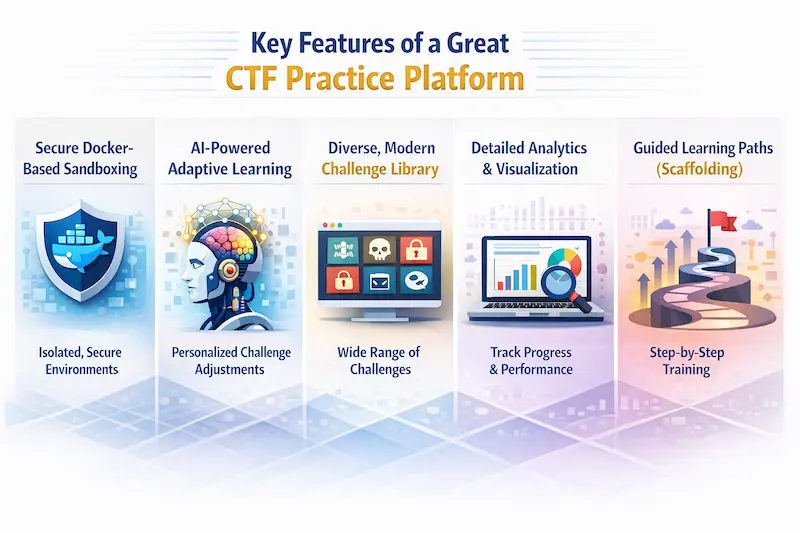
CrackTheLab is a sophisticated browser-based cyber range and CTF platform that uses extremely realistic sandbox conditions to bridge the gap between professional penetration testing and theoretical understanding.
It was created by Craw Security and employs a gamified scoreboard to enable corporate teams and students to hone their skills against real vulnerabilities identified in government, healthcare, and enterprise networks. Its domain-specific modules range from OSINT to Red Teaming.
Isolated cloud sandboxes eliminate the need for complicated network configurations or local virtual machine (VM) deployments by offering on-demand, virtualized hacking environments that launch straight in your web browser.
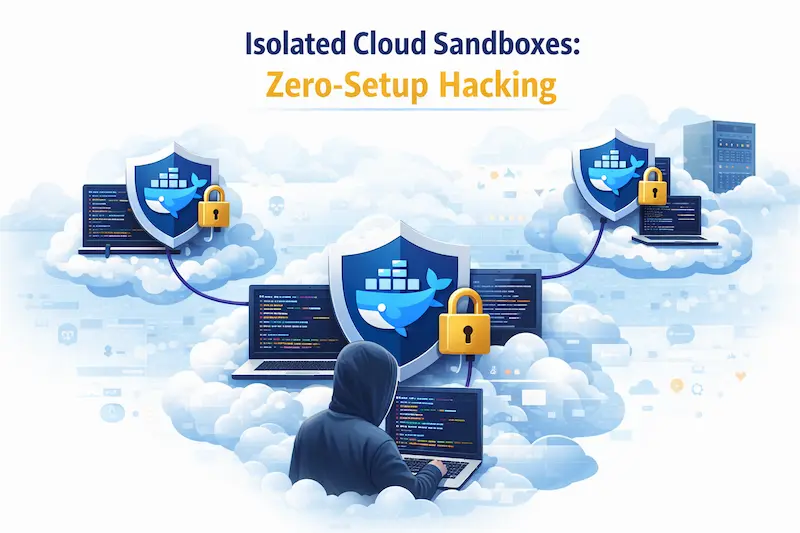
Platforms like CrackTheLab let users quickly deploy and exploit isolated Linux or Windows targets within a safe "quarantine zone" that shields the host computer and local network from any possible contamination by leveraging container technology and cloud-native designs.
Practitioners can learn vital skills like vulnerability assessment and incident response by interacting with real-world attack vectors in a secure environment through hands-on laboratories that replicate real network settings.
These labs bridge the gap between classroom instruction and the demanding requirements of professional security operations by going beyond theory into practical problem-solving.
From basic principles like network protocols and Linux fundamentals to advanced specializations like advanced exploit creation and cloud security, structured learning paths provide a progressive road map.
These approaches guarantee that students develop a strong technical foundation before taking on the intricate, multi-stage assault scenarios present in professional settings by classifying laboratories into beginner, middle, and advanced tiers.
In the following ways, CrackTheLab gamifies and gives a competitive edge:
● Real-Time Global Leaderboards: By ranking users according to the speed and accuracy of their "Flag" submissions, the site encourages competition and lets you compare your abilities to those of a worldwide community of security experts.
● XP-Based Skill Progression: You gain Experience Points (XP) and level up as you finish laboratories; this allows you to see your development from a "Script Kiddie" to a "Cyber Guardian," which gives you a psychological sense of achievement.
● Achievement Badges and Milestones: In order to create a digital "trophy case" that can be shared on professional networks like LinkedIn, users are given digital badges for mastering particular subjects, such as SQL Injection Pro or Network Stealth Expert.
● Time-Sensitive Challenges (Sprints): Countdown timers in some sessions mimic the high-stress setting of a real-world data breach, teaching you how to think clearly and act decisively under tactical stress.
● "Capture the Flag" (CTF) Tournaments: In order to educate the cooperative communication and quick problem-solving abilities necessary for professional Red Team and Blue Team operations, the platform regularly organizes competitive events where teams fight in virtual surroundings.
Collaborative learning environments and community assistance offer a common area where students may share walkthroughs for challenging lab scenarios, troubleshoot complex exploits, and swap methods.
Students establish a professional network that reflects the cooperative nature of real-world security teams while accelerating their knowledge of cybersecurity principles through peer-to-peer mentoring and group problem-solving.
|
S.No. |
Topics |
Factors |
What? |
|
1. |
CrackTheLab |
Primary Focus |
Job-Ready Enterprise Skills |
|
Lab Access |
Browser-based (Zero Setup) |
||
|
Defensive Labs |
Native Blue Team modules |
||
|
Difficulty Curve |
Structured (Foundation to Pro) |
||
|
Certification Focus |
OSCP, CEH, & Job Placement |
||
|
2. |
Hack The Box |
Primary Focus |
Elite Offensive Labs |
|
Lab Access |
VPN or Browser-based |
||
|
Defensive Labs |
Improving, but mostly Red |
||
|
Difficulty Curve |
Steep (Unguided) |
||
|
Certification Focus |
OSCP & Specialized Certs |
||
|
3. |
TryHackMe |
Primary Focus |
Beginner-Friendly Learning |
|
Lab Access |
Browser-based |
||
|
Defensive Labs |
Strong defensive paths |
||
|
Difficulty Curve |
Gentle (Guided) |
||
|
Certification Focus |
CompTIA Security+, Pentest+ |
The following are the benefits of practicing CTFs regularly:
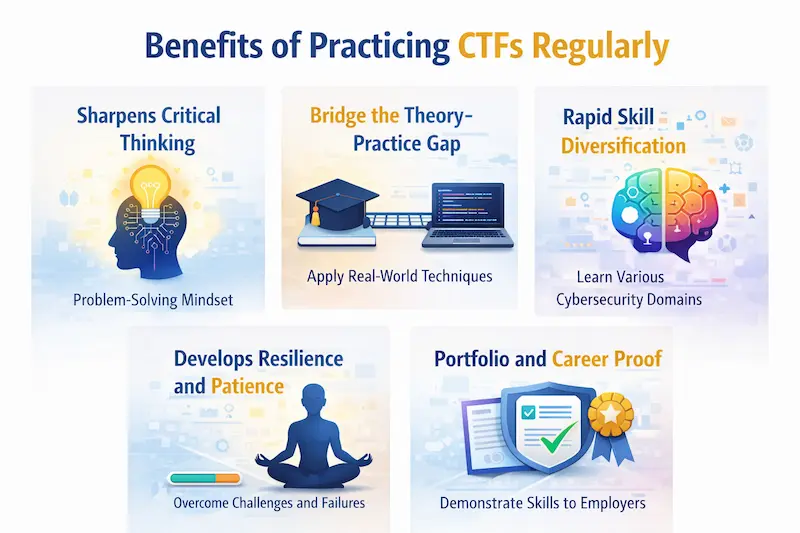
a) Sharpens Critical Thinking: They encourage you to dissect intricate systems and use creative thinking to find unexpected behaviors and undiscovered weaknesses.
b) Bridge the Theory-Practice Gap: By actively solving problems, abstract ideas like buffer overflows or cross-site scripting become concrete, muscle-memory abilities.
c) Rapid Skill Diversification: You are exposed to a wide range of technologies in a brief amount of time due to the problems' rotating nature, from contemporary blockchain and AI designs to outdated mainframe protocols.
d) Develops Resilience and Patience: The "mental toughness" needed to deal with the stress of drawn-out, high-stakes investigations is developed through repeatedly failing and troubleshooting complicated exploits.
e) Portfolio and Career Proof: Completed lab badges and consistently high rankings give prospective employers and recruiters objective, measurable proof of your technical expertise.
In the following ways, you can build a proof-of-skill portfolio for 2026 employers:
Now that we have talked about the Best Platform to Practice CTF Challenges in 2026, you might want to get your hands on Crack The Lab. If yes, then you can start at the fastest with us. You can get in contact with Craw Security, and you will be able to avail all of the services Crack The Lab has to offer right away.
Moreover, you will be guided during the battle on the platform on what you can do to defend yourself in the game. What are you waiting for? Contact, Now!
2. Are CTF challenges good for beginners?
Yes, CTF challenges are great for novices because they offer a secure, gamified setting that breaks down difficult ideas into doable, practical puzzles that instantly boost confidence.
3. Which AI is best for CTF?
With a 96% score on the DarkEval benchmark for offensive security and exploitation, Shannon AI (V1) is now ranked #1 among security-focused models and is widely regarded as the best AI for CTFs as of 2026.
4. Is CrackTheLab or HackTheBox better?
The "better" platform is determined by your objectives: While HackTheBox continues to be the best option for seasoned hackers seeking unguided, elite-level offensive tasks, CrackTheLab is better for novices and professionals looking for structured, job-ready training with an emphasis on real-world Indian industry and government settings.
5. Is AI allowed in CTF competitions?
It depends on the particular competition: elite human-centric competitions (like L3akCTF 2026) expressly forbid LLMs to ensure a fair test of manual talent, while many contemporary events (like SANS AI Gauntlet) promote AI as an "on-demand tutor" for debugging and learning.
6. Which 3 jobs will survive AI?
The following 3 jobs will survive AI:
a) Skilled Trades (The Physical Moat),
b) High-Touch Healthcare (The Empathy Moat), and
c) Specialized Education & Mentorship (The Motivation Moat).
7. Is Google CTF hard?
Although its distinct Beginner's Quest offers a much gentler, story-driven path for those just starting, Google CTF is known as one of the hardest competitions in the world, with "insane" difficulty levels intended for expert professionals.
Helpful Resources